
Knee Trauma Surgeon in Ahmedabad, Gujarat
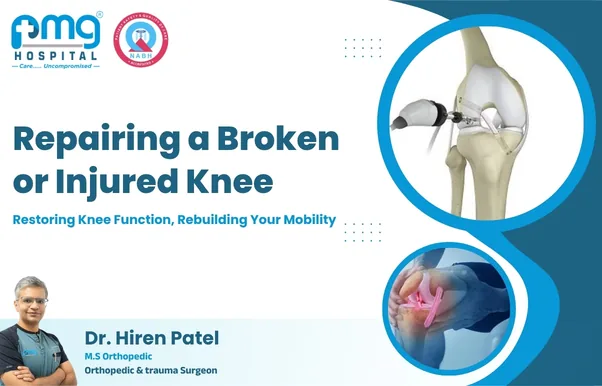
Repairing a Broken or Injured Knee
A fall, road accident or sporting collision can break the bones around the knee or tear its ligaments, meniscus or tendons. Dr. Hiren Patel treats knee trauma in Ahmedabad across the full range of these injuries - fracture fixation, ligament reconstruction, meniscus and cartilage surgery, and tendon repair - with each procedure chosen to restore the joint surface, stability and movement and to reduce the risk of early arthritis, at PMG Hospital.
- Patellar, tibial plateau and distal femur fracture fixation
- ACL and PCL ligament reconstruction
- Meniscus repair and cartilage restoration
- Knee dislocation and tendon repair
What is knee trauma surgery?
Knee trauma surgery repairs sudden injuries to the knee so the joint heals in the right position and moves well afterwards. The knee can be injured in two broad ways: the bones can break, as in a tibial plateau or kneecap fracture, or the soft tissues can tear, as in an ACL, meniscus or tendon injury - and often both happen together. When a fracture enters the joint surface, the goal is to rebuild a smooth, well-aligned surface, because even a small step in the joint can lead to early arthritis; where a ligament or tendon is torn, the goal is to restore the stability and movement the knee needs to work normally.
Common knee trauma injuries
The knee is a frequent site of serious injury because it bears weight and sits close to the surface. The injuries treated here include:
- Patellar (kneecap) fractures
- Tibial plateau fractures
- Distal femur and femoral condyle fractures
- Traumatic knee dislocation
- Ligament tears (ACL and PCL)
- Meniscus (cartilage cushion) tears
- Patellar and quadriceps tendon ruptures
- Articular cartilage injuries
Types of knee trauma surgery
Knee trauma can damage bone, ligament, cartilage or tendon, and the surgery is matched to the structure injured. Many minor or non-displaced injuries heal without surgery in a brace and physiotherapy; the procedures below are used when surgery is needed.
Fracture fixation
Displaced fractures of the kneecap, tibial plateau or distal femur are fixed with plates, screws or wires to rebuild the joint surface and alignment, with a temporary external fixator used where the surrounding skin and soft tissue are badly injured. Restoring a smooth joint surface is what lowers the long-term risk of arthritis.
ACL reconstruction
A torn anterior cruciate ligament, a common twisting or landing injury, is usually reconstructed arthroscopically with a graft to restore stability, particularly in active patients who want to return to sport. Read more about ACL reconstruction.
PCL reconstruction
The posterior cruciate ligament, often torn in a dashboard injury or a fall onto a bent knee, is treated with bracing and rehabilitation or with arthroscopic reconstruction, depending on the severity and any associated injuries. See PCL treatment.
Meniscus repair or meniscectomy
A torn meniscus - the knee's cartilage cushion - is either repaired to preserve it, which is preferred wherever the tear allows, or the damaged part is trimmed (partial meniscectomy) when a repair is not possible. More on meniscus surgery.
Tendon repair
A ruptured patellar or quadriceps tendon leaves you unable to straighten the knee and needs surgical repair to reattach the tendon, followed by protected rehabilitation to rebuild the extensor mechanism. This is treated promptly, as delay makes repair harder.
Cartilage restoration
Damaged articular cartilage on the joint surface is treated with techniques that stimulate or restore the surface, relieving pain and helping to delay the onset of arthritis in a younger knee. See cartilage restoration.
Recovery after knee trauma surgery
Recovery depends on what was repaired. After fracture fixation, weight-bearing is protected for the first several weeks; most patients use crutches or a walker with gentle movement starting early to prevent stiffness, and full weight-bearing returning around six to twelve weeks once X-rays confirm healing. After ligament reconstruction such as an ACL, a graft-protection programme guides bracing and a staged return to activity and sport over several months. Physiotherapy is central to every knee-trauma recovery, and follow-up confirms healing before full loading or return to sport; complete recovery of strength can take up to a year for the more serious injuries.

- Experience
- 14+ years
- Surgeries
- 14,000+
Knee trauma surgery specialist in Ahmedabad
Knee injuries are technically demanding; the joint surface must be reconstructed accurately, ligaments and tendons balanced, and vessels and nerves lie close behind the joint - so a knee trauma injury benefits from prompt, experienced orthopaedic care. Dr. Hiren Patel is an orthopaedic surgeon in Ahmedabad with 14+ years of practice and 14,000+ surgeries at PMG Hospital, treating knee fractures, dislocations, ligament and meniscus tears, cartilage damage and tendon ruptures. When choosing a knee trauma doctor or hospital in Ahmedabad, prompt assessment, accurate reconstruction, and a clear rehabilitation plan matter most. Learn more about Dr. Hiren Patel or explore the wider trauma and fracture care.
Frequently asked questions
Does every tibial plateau fracture need surgery?
No. An undisplaced tibial plateau fracture where the joint surface is still smooth and well aligned can often be treated without surgery, in a brace and keeping weight off the leg for several weeks. Surgery is needed when the surface has dropped or stepped, because plates and screws are used to rebuild a smooth surface and reduce the long-term risk of arthritis.
Does a torn ACL or meniscus always need surgery?
Not always. A partial ACL tear or a small, stable meniscus tear can sometimes settle with physiotherapy, while a complete ACL tear in an active person, a meniscus tear that locks the knee, or a ruptured tendon usually needs surgery. The decision is made on your symptoms, activity level and MRI findings.
How soon can I walk after knee trauma surgery?
Walking with crutches or a walker usually starts within days, but the leg is kept non- or partial weight-bearing for the first several weeks while a fracture or repair heals. Full weight-bearing generally returns around six to twelve weeks, once follow-up X-rays confirm healing, and the exact timing depends on the injury.
Does a knee fracture increase arthritis risk?
Yes. A fracture that enters the knee joint surface can raise the long-term risk of post-traumatic arthritis, which is exactly why surgery aims to restore the joint surface and alignment as accurately as possible. Good reduction and stable fixation lower that risk, though they cannot always eliminate it.
How is a dislocated knee treated?
A dislocated knee is reduced (put back in place) urgently, and the circulation and nerves are checked carefully, because a knee dislocation can injure the artery behind the knee. Because it usually tears several stabilising ligaments, the knee is then stabilised and the ligaments are repaired or reconstructed, sometimes alongside a fracture.