
Partial Knee Replacement Surgeon in Ahmedabad, Gujarat
Resurfacing Only the Damaged Knee Compartment
When arthritis or damage is limited to just one compartment of the knee and the ligaments - particularly the ACL - remain intact, partial (unicompartmental) knee replacement resurfaces only the damaged part and leaves the rest of your natural knee untouched. Dr. Hiren Patel is a partial knee replacement surgeon in Ahmedabad with 14+ years of experience and 14,000+ surgeries, using his own CROWN technique for a knee that recovers faster and feels more natural.
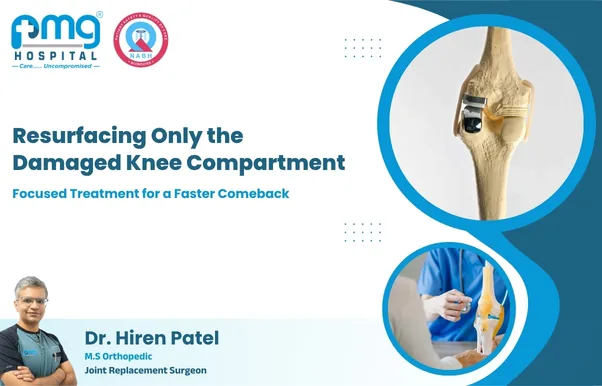
- Only the damaged compartment resurfaced
- Smaller incision, less surgical trauma
- Around 95% of patients recover within about 2 weeks
- Healthy bone, ligaments and cartilage preserved
What is partial knee replacement?
Partial knee replacement, also called unicompartmental knee replacement, resurfaces only the single worn compartment of the knee rather than the whole joint. The healthy cartilage, bone and ligaments in the other compartments are left completely undisturbed, including the ACL, which a total replacement often removes. Because so much of your own knee is preserved, the joint continues to move and feel closer to a natural knee, and if the arthritis ever spreads years later, a partial tear can usually be converted to a total replacement.
Who is a candidate for partial knee replacement?
Partial knee replacement suits patients whose arthritis or damage is confined to one compartment of the knee, with the ACL and other ligaments intact. It is best for early or localised osteoarthritis rather than widespread joint deterioration, in patients who want to preserve as much of their natural knee structure as possible. The final decision is made on standing X-rays and examination, which confirm that the other compartments and the ligaments are healthy.
The CROWN technique
Dr. Hiren Patel performs partial knee replacement using his own CROWN approach - Conserve, Restore, Only the affected part resurfaced, Without extended pain or physiotherapy, Natural feel. By targeting only the damaged part of the knee and leaving healthy bone, cartilage and ligaments in place, the technique aims for a smaller, gentler operation and a joint that behaves more like your own than a total replacement typically can.
Partial vs total knee replacement
The two operations treat very different knees. A partial replacement is the more conservative option when only one compartment is worn; a total replacement is the right choice once arthritis is widespread.
| Partial knee replacement | Total knee replacement | |
|---|---|---|
| Compartments resurfaced | Only the one worn compartment | All three compartments |
| Ligaments | ACL and others preserved | ACL usually removed |
| Incision & trauma | Smaller incision, less trauma | Standard incision |
| Recovery | Faster; light activity by 4–6 weeks | Everyday activity by 6–12 weeks |
| Best suited to | Localised, single-compartment arthritis | Widespread arthritis or deformity |
For widespread arthritis, see total knee replacement; for the full picture, read the knee replacement overview.
How partial knee replacement is performed
Through a smaller incision than a total replacement, only the worn compartment is exposed. The damaged cartilage and a thin layer of bone are removed, and a metal-and-plastic implant is fitted to resurface just that part of the joint. Because the healthy compartments, the kneecap mechanism and the ligaments are not disturbed, there is less soft-tissue trauma - which is a large part of why the early recovery is quicker and the knee feels more natural afterwards.
The TRINOVA Approach in Partial Knee Replacement
Alongside the CROWN technique, Dr. Hiren Patel applies three additional elements - together known as TRINOVA - to make partial knee replacement even more precise and gentle on the surrounding muscle and tissue.
Robotic assistance (ROSA)
ROSA measures the knee live during surgery, so implant size, position and limb alignment follow the surgical plan rather than the feel of the moment. In a partial replacement, this precision matters even more, since only the damaged compartment is being resurfaced and the healthy compartments must be protected from any misalignment.
Subvastus approach
The knee is opened underneath the vastus medialis instead of cutting through the quadriceps tendon, so the muscle that straightens your leg is left intact. Combined with the already-smaller CROWN incision, this further reduces muscle trauma, supporting a quicker return of natural knee movement.
Tourniquet-less surgery
The operation is done without a thigh tourniquet, so blood supply to the leg muscles is never cut off during surgery. This helps limit post-operative swelling and stiffness, which fits well with the faster, near-normal recovery that partial knee replacement patients typically expect.
Recovery after partial knee replacement
Hospital stay is typically two to three days, and walking with support is usually possible within a few days of surgery. Around 95% of patients recover within about two weeks, with a return to light activities by four to six weeks. The smaller incision and preserved ligaments mean less pain and a shorter physiotherapy course than a total replacement, though a steady home exercise routine still matters for the best result.
Partial knee replacement cost in Ahmedabad
Partial knee replacement in Ahmedabad typically ranges from Rs 1.5 lakh to Rs 3.5 lakh, depending on surgical method, implant type and hospital room category, often less than a total replacement because the operation is smaller. A written, itemised estimate follows your consultation and X-ray review, and cashless insurance pre-authorisation is coordinated where applicable. Figures are indicative and confirmed in writing after your consultation.

- Experience
- 14+ years
- Surgeries
- 14,000+
Partial knee replacement specialist in Ahmedabad
Choosing the right partial knee replacement doctor or hospital in Ahmedabad matters, because the result depends heavily on careful candidate selection; a partial replacement only works well when the arthritis is genuinely confined to one compartment. Dr. Hiren Patel is a partial knee replacement surgeon in Ahmedabad with 14+ years of practice and 14,000+ surgeries at PMG Hospital, and international fellowship training in joint replacement, the background behind the CROWN unicompartmental technique offered here. Learn more about Dr. Hiren Patel.
Frequently asked questions
How is partial knee replacement different from total knee replacement?
Partial replacement resurfaces only the single worn compartment and preserves your healthy bone, cartilage and ligaments — including the ACL — so the knee bends and feels more natural, through a smaller incision with a faster recovery. Total replacement resurfaces all three compartments and suits widespread arthritis. Which one fits you is confirmed on standing X-rays.
What is the CROWN technique?
CROWN is Dr. Hiren Patel's partial knee replacement approach: Conserve, Restore, Only the affected part resurfaced, Without extended pain or physiotherapy, Natural feel. It focuses on treating just the damaged compartment while leaving the healthy parts of the knee undisturbed.
How soon can I walk after partial knee replacement?
Walking with support is usually possible within a few days of surgery. Most patients recover within about two weeks and return to light activities by four to six weeks, helped by the smaller incision and preserved ligaments.
Am I a candidate for partial knee replacement?
You may be suitable if arthritis or damage is limited to one compartment of the knee, your ACL and other ligaments are intact, and the remaining compartments are healthy. Suitability is confirmed on standing X-rays and clinical examination.
What does partial knee replacement cost in Ahmedabad?
Partial knee replacement in Ahmedabad typically ranges from Rs 1.5 lakh to Rs 3.5 lakh, depending on surgical method, implant type and hospital room category. A written estimate follows your consultation and X-ray review, and it is often lower than a total knee replacement.