
Revision Shoulder Replacement Surgeon in Ahmedabad, Gujarat
Restoring a Failed Shoulder Implant
Revision shoulder replacement surgery replaces a failed artificial shoulder implant - removing the old components and placing a new one to restore stability and pain-free movement. These procedures are more complex than a primary shoulder replacement, requiring specialised implants, careful planning and specific surgical expertise. Dr. Hiren Patel is a revision shoulder replacement surgeon in Ahmedabad with 14+ years of experience and 14,000+ surgeries, managing complex and infected revision cases at PMG Hospital.
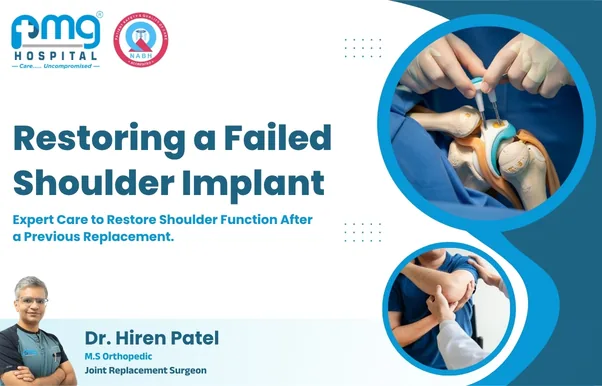
- For loosened, infected, unstable or worn implants
- Removal, bone preparation and new implant placement
- Bone grafts or specialised implants where needed
- Full recovery may take up to a year
What is revision shoulder replacement?
Revision shoulder replacement is surgery to remove a previously implanted shoulder prosthesis that has failed and replace it with a new one. It is not a repeat of the first operation - bone stock may have been lost and needs rebuilding, the rotator cuff and soft tissues must be reassessed, and any infection has to be cleared first. In many cases a failed anatomic implant is converted to a reverse design, which restores stability by letting the deltoid muscle power the arm. The aim is to correct whatever caused the original implant to fail and return the shoulder to reliable, pain-free movement.
Causes of shoulder implant failure
Identifying the exact cause is what decides the revision plan. The main causes are:
- Implant loosening — the components work loose from the bone over time
- Infection — bacteria form a biofilm on the implant that antibiotics alone cannot clear
- Shoulder instability — the joint repeatedly slips out of position, often linked to rotator cuff or soft-tissue failure
- Wear and tear — the bearing surfaces wear and debris can trigger bone loss
- Fracture around the implant — a break in the bone near the components, often after a fall
How revision shoulder surgery is performed
Surgery begins with imaging - X-rays and often a CT scan to map bone loss - and infection testing, because whether infection is present changes the whole plan. The old implant is then carefully removed while preserving as much healthy bone as possible, the bone surfaces are prepared, and a new implant is placed. Where bone has been lost or the rotator cuff can no longer stabilise the joint, bone grafts or specialised revision implants are used, and a failed anatomic replacement is frequently converted to a reverse design for stability. This makes the procedure considerably more involved than a first-time replacement.
Treating an infected implant: two-stage revision
An infected shoulder implant is usually treated in two stages. In the first operation the implant is removed, the joint is thoroughly cleaned, and a temporary antibiotic-loaded spacer is placed, followed by several weeks of antibiotics. Once tests confirm the infection has cleared, a second operation fits the final new implant. This staged approach exists because bacteria form a biofilm on the old implant that cannot be reliably cleared while any of the original hardware remains.
Recovery after revision shoulder replacement
Recovery after a revision shoulder replacement is slower than after a first-time replacement, combining sling protection, physiotherapy and a gradual return to activity. The arm is supported in a sling early on, and rehabilitation progresses in phases so a healing repair is not stressed too soon. Most patients regain useful function over several months, and full recovery can take up to a year, depending on the extent of the revision, whether infection was involved, and individual healing.

- Experience
- 14+ years
- Surgeries
- 14,000+
Why revision surgery needs an experienced specialist
Revision shoulder replacement is complex work: the failed implant must be removed without sacrificing bone, defects must be rebuilt, the joint must be made stable - often by converting to a reverse design - and infection must be recognised and managed correctly. This depends on specialised revision implants, careful planning and refined technique, which is why patients look specifically for an experienced revision shoulder replacement surgeon, doctor or hospital in Ahmedabad rather than for primary-replacement volume alone.
Dr. Hiren Patel brings 14+ years of practice and 14,000+ surgeries, including a dedicated international fellowship in Sports Medicine & Shoulder Surgery at St. Mary's Catholic Hospital, Seoul, South Korea, to failed, loosened and infected shoulder implants. Because revision uses specialised implants and takes longer than a first replacement, its cost is usually higher and is quoted individually after assessment. Learn more about Dr. Hiren Patel, or read the wider shoulder replacement overview.
Frequently asked questions
Why would a shoulder implant need to be revised?
A shoulder implant may need revision if it loosens, becomes infected, wears out, makes the joint unstable, or if the bone around it fractures. These problems can appear years after an otherwise successful replacement, so returning pain, weakness or instability long afterwards should always be assessed.
Is revision shoulder replacement more complex than the first surgery?
Yes. The old implant must be removed without damaging bone, lost bone often has to be rebuilt with grafts or specialised implants, the rotator cuff and stability must be managed, and any infection cleared first. It frequently involves converting to a reverse implant, so outcomes depend heavily on the surgeon's revision experience.
Can a failed shoulder replacement be converted to a reverse implant?
Yes, and it is one of the most common revision solutions. When a failed anatomic replacement has left the shoulder unstable or the rotator cuff no longer works, converting to a reverse design lets the deltoid muscle power the arm and restores stability. Whether it suits your shoulder is decided on imaging and the state of the bone and soft tissues.
How long does recovery take?
Recovery is slower than after a first-time shoulder replacement. Most patients regain useful function over several months, with full recovery taking up to a year, depending on the extent of the revision and whether infection was treated.