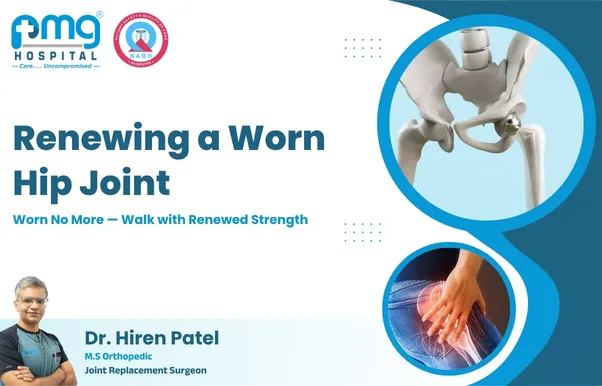
Total Hip Arthroplasty
Hip Replacement Surgeon in Ahmedabad, Gujarat
Hip arthritis or avascular necrosis can make every step painful and disturb sleep. Dr. Hiren Patel, a hip replacement surgeon in Ahmedabad with 13+ years of experience and 11,000+ successful joint surgeries, replaces the damaged ball and socket with smooth, low-friction implants, allowing you to walk, climb stairs and resume daily life without the constant ache.

- Total, partial and revision hip replacement
- Anterior and posterior surgical approaches
- Cemented, uncemented and dual-mobility options
- Standing and walking the same day of surgery
What is hip replacement?
Hip replacement (hip arthroplasty) removes a damaged femoral head and worn socket and replaces them with an artificial ball and cup, recreating a smooth, low-friction joint. It is one of the most reliable procedures in orthopedic surgery for relieving hip pain and restoring the ability to walk, climb stairs and sleep without the joint constantly aching.
It helps to understand what is actually replaced. The femoral head - the ball at the top of the thigh bone - is removed and substituted with a metal or ceramic ball fixed to a stem inside the thigh bone. The worn socket in the pelvis is lined with a durable cup and liner rather than removed entirely. The surrounding muscles, tendons and most of the pelvis and thigh bone are left untouched; only the two worn surfaces that grind against each other are replaced.
In Ahmedabad and across Gujarat, patients usually reach this decision after years of groin or thigh pain that has spread to affect walking distance, sleep and the ability to sit or rise from a chair without help. As with the knee, the operation is rarely decided at the first visit - it is offered once non-surgical treatment has genuinely stopped working.
Who needs hip replacement?
Hip replacement is considered when the hip joint is too damaged for conservative care and quality of life is affected. Groin pain that radiates to the thigh or knee, a limp that appears after walking a short distance, and stiffness that makes putting on socks or shoes difficult are the most common early signs.
- Osteoarthritis of the hip
- Avascular necrosis (AVN) of the femoral head
- Rheumatoid and inflammatory arthritis
- Hip fracture in older patients
- Failed previous hip surgery or a loose implant
- Developmental dysplasia of the hip presenting with early arthritis in adulthood
Avascular necrosis deserves particular attention because it often affects younger patients - sometimes in their thirties or forties - and can progress from mild pain to joint collapse within months if ignored. Any patient with risk factors such as long-term steroid use or heavy alcohol intake who develops new groin pain should be assessed promptly rather than waiting.
Types of hip replacement offered
The right procedure depends on which parts of the joint are damaged, your bone quality and, in the case of fracture, how well the ball of the hip is still supplied with blood.
- Total hip replacement - both the ball and socket resurfaced
- Partial hip replacement (hemiarthroplasty) - only the femoral head replaced
- Revision hip replacement for failed, loose or infected implants
- Anterior and posterior surgical approaches, selected on individual anatomy
- Bilateral hip replacement in one sitting for selected patients
| Type | Best suited for | Hospital stay | Typical return to routine |
|---|---|---|---|
| Total hip replacement | Both the femoral head and the acetabular socket are worn | 3 – 5 days | 6 – 12 weeks |
| Partial hip replacement (hemiarthroplasty) | Femoral neck fracture in older patients with a healthy, undamaged socket | 3 – 6 days | 6 – 12 weeks |
| Revision hip replacement | Loosening, dislocation, wear or infection in a previous hip implant | 5 – 8 days | 3 – 6 months |
| Bilateral (both hips together) | Both hips severely arthritic, patient medically fit for a longer procedure | 4 – 6 days | 8 – 14 weeks |
Timelines are typical ranges for this practice and are individualised after your assessment.
Diagnosis before hip replacement
A confident diagnosis is built from three things that must agree: what the hip is doing to your daily life, what the examination finds, and what the imaging shows. Groin pain is not always the hip - the lower back and even the knee can refer pain there - so the examination is what separates a true hip problem from an impostor.
How is hip damage diagnosed?
The consultation begins with questions about where exactly the pain is felt - true hip arthritis is usually felt in the groin, sometimes radiating to the front of the thigh or knee, rather than over the outer hip or lower back. How far can you walk? Does putting on socks or shoes provoke pain? Can you get in and out of a car comfortably? Does the pain wake you at night, particularly when lying on that side?
The examination checks the range of hip motion in every direction, looks for a limp or shortening of the leg, and specifically tests internal rotation - loss of internal rotation with the hip and knee bent is one of the earliest and most reliable signs of hip arthritis. The lower back and knee are examined in the same visit to rule out referred pain, since treating the wrong joint helps no one.
What X-rays are needed?
A standing pelvis X-ray showing both hips together, plus a lateral (frog-leg or cross-table) view of the affected hip, remains the primary investigation. Comparing both hips on one film makes subtle joint space narrowing far easier to spot than looking at one hip in isolation.
- Standing AP pelvis view, showing both hips together for comparison
- Lateral or frog-leg view of the affected hip
- Full-length hip-to-ankle scanogram when leg length discrepancy is suspected
- Additional views for suspected dysplasia or a previous childhood hip condition
Arthritis severity is graded on the same Kellgren–Lawrence scale used for the knee; grade 4, with visible bone-on-bone contact and cyst formation, combined with genuine disability, is the strongest indication for replacement.
Is an MRI required?
For advanced arthritis visible clearly on X-ray, an MRI adds little. It becomes genuinely useful in a smaller set of situations, and is used selectively rather than routinely.
- Suspected avascular necrosis in its earliest stage, before it is visible on X-ray
- Groin pain with a near-normal X-ray, to look for labral tears or early cartilage loss
- Suspected stress fracture of the femoral neck in an osteoporotic patient
- Assessment of a soft-tissue mass or suspected infection
What other tests are done before surgery?
Once surgery is decided, the workup shifts to making the operation safe and ruling out every hidden source of infection, exactly as for knee replacement, since a hip implant is equally dependent on a sterile field to succeed long-term.
- Complete blood count, ESR and CRP
- Fasting sugar and HbA1c, with surgery deferred if control is poor
- Kidney and liver function, coagulation profile and blood grouping
- Viral markers and urine routine with culture where indicated
- Vitamin D and calcium levels, corrected before surgery
- ECG for everyone, and cardiology clearance where age or history requires it
- Dental examination to clear any hidden infection
- Pre-anaesthesia consultation to plan the spinal or general anaesthetic
Medicines to discuss in advance
Blood thinners, aspirin, some diabetes medicines and disease-modifying drugs for rheumatoid arthritis usually need adjustment several days before surgery. Bring your actual strips or a written list, and never stop a cardiac medicine on your own.
How does the surgeon decide if surgery is needed?
The same three conditions apply as for the knee: disabling pain that you can describe concretely, imaging that explains that pain, and honest conservative treatment tried for three to six months without lasting relief. Hip fractures in older patients are the clear exception - surgery is usually recommended promptly rather than trialled against conservative care, since prolonged bed rest in the elderly carries its own serious risks.
Treatment options before hip replacement
Early and moderate hip arthritis often responds well to a structured non-surgical programme, and the same programme improves fitness for whenever surgery eventually becomes necessary.
Medicines for hip pain
Paracetamol at an adequate dose remains a safe first step. Anti-inflammatories help flare-ups but are intended for short courses of five to ten days, not daily long-term use, because of the strain they place on the kidneys and stomach lining in exactly the age group most likely to need them. Correcting vitamin D deficiency, common in Gujarati patients, measurably improves muscle strength and bone quality and is done routinely.
Physiotherapy
The hip abductor and core muscles act as the joint's stabilisers. A structured six to twelve week programme of hip abductor strengthening, gentle range-of-motion work and gait retraining reduces the limp and the load transmitted through the joint with every step, often reducing pain meaningfully without any medicine at all.
Exercise and weight management
Every kilogram of body weight multiplies into several times that force across the hip during walking. Weight reduction of five to ten per cent produces a noticeable drop in pain - a change no injection or medicine can match.
- Stationary cycling with low resistance - gentle on the hip while building fitness
- Swimming or pool walking, which builds strength with almost no joint loading
- Walking on flat ground in cushioned shoes, in shorter and more frequent sessions
- A walking stick held in the hand opposite the painful hip, which meaningfully reduces joint load
- Avoid deep squats, prolonged standing on hard floors, and high-impact activity
Injections for hip pain
Corticosteroid injections into the hip joint are given under X-ray or ultrasound guidance, since the hip is a deep joint that cannot be injected blindly with reliability. Relief typically lasts several weeks to a few months and is useful for getting through a specific event or a pilgrimage. As with the knee, no steroid injection is given within three months of a planned replacement, since it increases infection risk. Hyaluronic acid and PRP injections are used selectively in earlier arthritis, with more modest and variable results than in the knee.
Lifestyle changes
- Switch to a Western commode, or use a raised toilet seat
- Use a chair with armrests and a firm seat at hip height; avoid low sofas and diwans
- Sit on a chair for prayer, meals and family gatherings rather than on the floor
- Keep frequently used items at waist level to reduce bending
- Wear cushioned closed footwear indoors
- Control diabetes, blood pressure and thyroid function ahead of any planned surgery
When do these treatments stop working?
- Pain at rest or at night, waking you from sleep
- Walking distance shrinking to a few minutes, or a permanent limp
- Painkillers needed on most days of the week just to function
- Difficulty putting on socks or shoes, or getting in and out of a car
- Visible shortening of the leg or a worsening limp noticed by family
- Stopping walks, travel or social events because of the hip
When several of these are true together, continuing to manage the hip with medicines mostly buys discomfort rather than time, and the deformity and muscle wasting that develop while waiting make the eventual surgery technically harder.
Hip replacement surgery: step by step
What happens on the day of surgery?
Admission is usually the previous evening or early on the morning of surgery, after fasting for six to eight hours. An antiseptic bath is done the night before and again in the morning, and hair is clipped rather than shaved immediately before the procedure. On the ward, jewellery and dentures are removed, an intravenous line is started, and the first dose of antibiotic is given within an hour of the incision. The surgeon marks the correct leg with you present, and the full surgical team confirms your name, the procedure, the side and the implants kept ready before the first cut.
How is anaesthesia given?
Most hip replacements are done under spinal anaesthesia with light sedation, which is associated with less blood loss and a clearer head afterwards than general anaesthesia. A regional nerve block may be added for additional pain control. General anaesthesia is used when a spinal is not suitable. Throughout the procedure, heart rate, blood pressure and oxygen levels are monitored continuously.
How is the joint exposed and prepared?
Depending on your anatomy and the surgeon's assessment, either a posterior or an anterior approach is used. The posterior approach works from the back of the hip, temporarily detaching and later repairing a small group of external rotator muscles; it is the most established and versatile approach for the widest range of hip conditions. The anterior approach works in the interval between muscles rather than through them, which can mean less early pain, though it suits a narrower range of anatomy.
The damaged femoral head is removed at a calculated angle, and the socket is prepared by reaming away the worn cartilage down to healthy bleeding bone, sized precisely to seat the new cup.
How is the artificial joint placed?
The acetabular cup is fixed into the prepared socket at the correct depth and angle, and a liner is snapped into it. A stem is placed into the hollow of the thigh bone, either press-fit or cemented depending on bone quality, and a trial head is fitted. The hip is then put through a full range of movement to check stability, leg length and the risk of impingement before the definitive ball is locked onto the stem. Getting leg length and offset correct at this stage is one of the most important technical steps in the entire operation - get it right and the patient walks without a limp; get it wrong and even a well-fixed implant feels wrong to the patient.
How is the hip tested?
Before closing, the hip is taken through flexion, rotation and the specific movements that could risk dislocation, to confirm it remains stable throughout a normal range of motion. Leg lengths are compared, and stability is confirmed with gentle traction and rotation under direct vision.
How is the wound closed?
A local anaesthetic and anti-inflammatory cocktail is infiltrated around the joint before closure to control the first night's pain. If the posterior approach was used, the small external rotator muscles are carefully repaired back to bone. The layers are closed with absorbable sutures and a subcuticular skin closure, and a waterproof, breathable dressing is applied.
How long does hip replacement surgery take?
Single hip, skin to skin
60 – 90 minutes
Complex revisions or significant deformity can take longer.
Total theatre time
About 2 – 2.5 hours
Includes anaesthesia, positioning, dressing and shifting.
Both hips in one sitting
3 – 3.5 hours
Offered to medically fit patients with cardiac clearance.
Families waiting outside should plan for roughly two and a half to three hours between the patient leaving the room and returning to it.
Hip replacement implants
As with the knee, the implant is chosen by the surgeon to suit your bone quality, age and activity level, and explained to you before surgery rather than presented as a price list to choose from.
What is a hip implant?
A hip implant has four main parts: a femoral stem that sits inside the thigh bone, a femoral head that forms the new ball, an acetabular cup that sits in the prepared socket, and a liner between the head and cup that provides the low-friction bearing surface. Together they recreate the ball-and-socket movement of a natural hip.
What are hip implants made of?
- Titanium alloy for most femoral stems, valued for its strength and ability to bond with bone
- Cobalt-chromium or ceramic for the femoral head, chosen for a smooth, hard, low-wear surface
- Highly cross-linked polyethylene, often vitamin-E infused, for the acetabular liner
- Ceramic liners for the lowest-wear bearing combination in suitable patients
- Antibiotic-loaded PMMA bone cement for cemented fixation
- Nickel-free or titanium-nitride coated options for documented metal allergy
Types of hip implants
| Implant type | What it does | Typically chosen for |
|---|---|---|
| Cemented | Stem and cup fixed to bone with surgical cement | Older patients and softer, osteoporotic bone |
| Uncemented (press-fit) | A textured surface allows bone to grow directly onto the implant | Younger patients with good bone quality |
| Hybrid | Cemented stem with an uncemented cup, or the reverse | Selected anatomy where mixed fixation performs best |
| Ceramic-on-ceramic | A ceramic head against a ceramic liner, the lowest-wearing bearing available | Younger, more active patients wanting maximum longevity |
| Ceramic-on-polyethylene | A ceramic head against a highly cross-linked plastic liner | A reliable, widely used combination across age groups |
| Metal-on-polyethylene | A cobalt-chromium head against a plastic liner | Cost-conscious patients with lower activity demands |
| Dual mobility | A mobile plastic bearing inside the cup lowers dislocation risk | Revision surgery, elderly or neurologically at-risk patients |
How is the right implant selected?
The choice is guided by your X-rays, bone density, the degree of deformity, and how you live day to day. A younger patient who intends to stay active for decades is assessed differently from an elderly patient recovering from a fracture, where stability and a quick, safe recovery matter more than bearing longevity.
Costliest is not always correct
A ceramic-on-ceramic bearing is not automatically the right choice for every patient. What predicts a good result over fifteen to twenty-five years is correct implant sizing, accurate positioning, restored leg length and offset, and a clean, infection-free procedure. You will always be told which features a premium option buys you and whether they are relevant to your situation.
How long do hip implants last?
Modern hip implants commonly last fifteen to twenty-five years, with national joint registries reporting roughly ninety per cent still functioning well at fifteen years. What shortens implant life is largely the same as for the knee: excess body weight, high-impact activity, poor implant positioning, and above all infection reaching the joint through the bloodstream from an untreated dental, skin or urinary infection.
Life after hip replacement
These are the questions patients ask most often. The hip carries one consideration the knee does not: movement precautions that protect the joint from dislocation while the surrounding tissues heal, particularly after a posterior approach.
When can you walk after surgery?
The same day, in most cases. Once the spinal wears off, the physiotherapist helps you stand and take a few steps with a walker, following the hip precautions taught at the bedside. By the second day most patients walk to the bathroom and along the corridor.
When can you climb stairs?
Stair practice starts before discharge, using the same "good leg up, operated leg down" rule as the knee, with a hand always on the railing. Comfortable, unassisted stair climbing typically returns between six and eight weeks.
When can you drive?
For a right hip, four to six weeks; for a left hip in an automatic car, three to four weeks. You must be off strong painkillers and confident performing an emergency brake. Getting in and out of the car itself needs practice early on, keeping the knees apart and lowering slowly.
When can you return to work?
- Desk or office work: 3 – 4 weeks, with breaks to stand and walk every hour
- Work from home or light supervisory work: often from the second or third week
- Teaching, retail or work involving standing for hours: 8 – 12 weeks
- Frequent travel or field work: 8 – 12 weeks
- Heavy manual labour or work involving ladders and squatting: 3 – 4 months
When can you exercise?
Walking remains the backbone of recovery from day one. Stationary cycling with the seat raised begins around week three to four. Swimming is excellent once the wound is fully healed, at four to six weeks, avoiding breaststroke kick early on. Light gym work under guidance can restart at six to eight weeks. High-impact sport is generally discouraged permanently, in favour of walking, cycling and swimming.
When can you travel?
Short car journeys are comfortable from two to three weeks with regular stops to stand and stretch. Longer travel and flights are advised after four to six weeks, with compression stockings, aisle seating and ankle pumps every half hour to protect against clots. Modern implants can trigger airport metal detectors; a card from the clinic makes security simple.
What activities and positions should you avoid?
- Bending the hip past 90 degrees - low chairs, low beds and deep squats
- Crossing the legs or ankles while sitting or lying, especially in the early weeks
- Twisting the operated leg inward, such as pivoting on the foot while turning
- Sitting or sleeping on the floor, and Indian-style toilets
- Running, jumping and high-impact or contact sports
- Lifting heavy weights while bending forward from the hip
- Ignoring any dental, urinary or skin infection - treat it promptly and mention your implant to the treating doctor
These precautions are strictest in the first six weeks and are relaxed gradually on your surgeon's advice - see the physiotherapy section below for the typical timeline.
Recovery after hip replacement
Most patients are encouraged to stand and walk with support on the day of surgery. Discharge is usually on day three to five. By two weeks many patients walk with a single stick, and by six weeks most can walk unaided and drive.
Here is what each stage actually looks like.
First 24 hours
Standing, and the first assisted steps
You return to the room with the leg supported and hip precautions explained by the nursing and physiotherapy team. Sensation returns over four to six hours as the spinal wears off; ankle pumps start immediately. The physiotherapist gets you standing with a walker and taking a few steps the same evening in most cases. Ice is applied for fifteen to twenty minutes several times, and the first night is usually the most disturbed one.
Days 2 – 5
Walker to corridor, and going home
Walking distance increases each day and stair practice is added using the hip precautions taught at the bedside. Swelling and bruising around the thigh peak around day three to five. Discharge is usually on day three to five for a single hip. You go home with a walker, a written precautions sheet, pain medicines, a blood thinner, and a raised toilet seat if needed.
Weeks 2 – 4
Independence at home
The walker is exchanged for a stick between weeks two and three for many patients. Walking indoors without support becomes possible for some by the end of week three. Sutures are removed or absorbed by day twelve to fourteen, and hip precautions remain in force throughout this stage even as confidence grows.
6 weeks
Outdoors, driving and back to work
This review point is where the hip typically turns the corner. Expect a comfortable outdoor walk, no walking aid for many patients, a return to desk work and driving, and the first easing of hip precautions once X-rays and strength are checked.
3 months
Near-normal daily function
Walking looks and feels normal, most formal precautions are lifted after review, and travel, social events and longer walks are back on the calendar. Strength continues to build steadily through this period.
6 – 12 months
Final strength and settling
Muscle strength around the hip continues to improve for up to a year. Occasional clicking, mild groin tightness after long activity, and a numb patch near the scar are normal and gradually fade. Follow-up continues at one year and then every two to three years with an X-ray.
How long does full recovery take?
Functional recovery - walking, stairs, driving, work, normal household life - takes about three months. Complete recovery, meaning full strength, stamina and the confident lifting of most day-to-day precautions, takes six to twelve months. Patients who arrive with reasonable hip and core strength and controlled body weight consistently reach these milestones earlier than the averages quoted here.
Physiotherapy after hip replacement
Why is physiotherapy important?
Surgery removes the source of the pain. Physiotherapy rebuilds the hip abductor and core muscles that were weakened by months or years of limping, and it teaches the movement patterns that keep the new joint safely inside its stable range while the repaired tissues heal. Patients who skip this stage often walk with a persistent limp even though the implant itself is functioning perfectly.
Exercises after hip replacement
As with the knee, short frequent sessions work better than one long session in the early weeks.
- Ankle pumps - 10 repetitions every hour while awake, from the day of surgery
- Static quadriceps and gluteal squeezes - hold 5 seconds, 10 repetitions
- Heel slides within the precaution range, to maintain hip flexion
- Straight leg raise once cleared by the physiotherapist, keeping the knee locked
- Standing hip abduction holding a support, moving the leg out to the side and back
- Seated marching, lifting the knee gently within the safe range
Respect the precautions before chasing range of motion
Unlike the knee, chasing maximum hip bending early is not the goal - protecting the repair while strength rebuilds is. Follow the precaution sheet given at discharge exactly, and let your surgeon decide when it is safe to relax them.
Hip precaution timeline
Precautions are strictest in the first six weeks, when the repaired tissues are at their weakest, and are relaxed in stages based on your progress and X-ray findings.
| Stage | Precaution level | What this means day to day |
|---|---|---|
| Weeks 0 – 6 | Full precautions | No bending the hip past 90°, no crossing legs or ankles, no twisting the operated leg inward |
| Weeks 6 – 12 | Relaxing gradually | Low chairs and floor sitting still avoided; crossing legs briefly may be allowed on review |
| 3 months onward | Reviewed individually | Most day-to-day precautions lifted once muscle strength and stability are confirmed |
Timelines are typical for a posterior approach; an anterior approach may allow earlier relaxation on your surgeon's advice.
Walking exercises
Walk with even, unhurried steps, avoiding the tendency to lean away from the operated side. Short frequent walks build a normal pattern better than one long walk: five minutes several times a day in week one, building to twenty to thirty minutes twice a day by six weeks. The walker or stick is discarded once you can walk without leaning on it and without a limp - not on a fixed calendar date.
Strengthening exercises
From around week four, once the wound has healed, resistance work is added: standing hip abduction and extension with a light band, mini squats within the precaution range, step-ups on a low step, and stationary cycling with light resistance. Hip abductor strength in particular is trained deliberately, since it is what stops the pelvis dropping on the opposite side with every step - the muscle most responsible for a normal, limp-free walk.
How long is physiotherapy needed?
Supervised sessions typically run for four to six weeks, followed by a home programme for three to six months. A short maintenance routine of fifteen to twenty minutes should continue permanently to protect hip abductor strength, particularly in patients who sit for long periods at work.
Pain after hip replacement
Is hip replacement surgery painful?
The surgery itself is painless under spinal anaesthesia. The first two to three days afterwards are uncomfortable rather than severe, felt mainly as a deep ache in the groin, buttock and thigh, and are well controlled with a multimodal protocol. Most patients describe the pain as noticeably milder than they expected, and by six weeks report that it is already less than the arthritis pain they lived with before surgery.
How is pain controlled after surgery?
- Local infiltration of an anaesthetic cocktail into the tissues around the joint before closure
- Scheduled intravenous paracetamol and an anti-inflammatory, given by the clock rather than on demand
- Opioids reserved as rescue medication only, in small doses
- Tranexamic acid to reduce bleeding and swelling around the joint
- Ice and elevation for the first seventy-two hours
- Early walking, which genuinely reduces pain from the second day onwards
How long does pain last?
| Period | What to expect |
|---|---|
| Days 1 – 3 | Sharpest phase. Deep ache in the groin and thigh, controlled by scheduled medicines and ice. |
| Days 4 – 14 | Steadily improving. Pain now mostly with walking and physiotherapy, easing at rest. |
| Weeks 3 – 6 | Discomfort rather than pain, mainly at the end of an active day. Night pain should have gone. |
| Weeks 6 – 12 | Occasional groin tightness with prolonged walking. Regular painkillers no longer needed. |
| 3 – 12 months | Mild ache after a long day or in cold weather, gradually fading as muscles fully recondition. |
When is pain after surgery not normal?
Recovery pain follows a downward trend. Anything that reverses that trend, or any episode suggesting the hip has moved out of position, needs a same-day call rather than waiting for the next appointment.
Contact the clinic immediately if you notice
- Sudden severe pain with the leg appearing shortened or rotated
- A popping sensation followed by inability to bear weight - possible dislocation
- Fever above 100.4°F, chills, or feeling generally unwell
- Wound discharge, spreading redness, or a wound that stays wet beyond a few days
- Calf pain, tenderness or swelling, especially with breathlessness
- Pain not relieved by your prescribed medicines at all
- Pain that returns weeks or months after a pain-free period
Hip replacement cost in Ahmedabad, Gujarat
Hip replacement in Ahmedabad generally costs between Rs 1.5 lakh and Rs 4.5 lakh, covering surgeon fees, implant, hospital stay, anaesthesia and post-surgery physiotherapy. A written, itemised estimate is provided after your X-rays and examination are reviewed, and most health insurance policies cover the procedure once the joint replacement waiting period is complete.
Located in Gota on S.G. Highway, the clinic is easily reachable from Satellite, Vastrapur, Thaltej, Bopal and Gandhinagar, and draws hip replacement patients from across Gujarat - Nadiad, Mehsana, Anand, Surat, Vadodara and Rajkot. Written estimates, cashless insurance and video follow-up make the process straightforward for local and outstation patients.
| What the estimate covers | Included |
|---|---|
| Implant and instrumentation | Stem, head, cup and liner cost, stated separately |
| Surgeon and anaesthesia fees | Including the spinal or nerve block and intra-operative monitoring |
| Hospital stay | Room category, nursing, OT charges and consumables for 3 – 5 days |
| Investigations and medicines | Pre-operative workup, in-hospital medicines and dressings |
| Physiotherapy | In-hospital sessions and the initial supervised programme |
| Follow-up | Reviews at 6 weeks, 3 months and 1 year |
Figures are indicative for Ahmedabad, Gujarat and are confirmed in writing after your consultation.

13+ yrs
Experience
11,000+
Joint surgeries
Meet your surgeon
Hip Replacement Surgery Specialist in Ahmedabad, Gujarat
Dr. Hiren Patel is a hip replacement surgeon in Ahmedabad with 13+ years of practice and 11,000+ successful joint surgeries at PMG Hospital, Gota, including a dedicated international fellowship in hip arthroplasty at Balgrist University Hospital, Switzerland and the Galeazzi Institute of Orthopedics, Milan, Italy.
Consultations run Monday to Saturday at Gota, with Sunday appointments on request for patients travelling from other districts of Gujarat. Second opinions on X-rays and on a hip replacement already advised elsewhere are welcome, including for patients who ultimately decide against surgery.
Frequently asked questions
How long does a hip replacement last?
Most hip replacements last 15 to 25 years, depending on implant material, patient weight and activity level. Younger, active patients may need a harder-wearing bearing surface.
How much does hip replacement cost in Ahmedabad?
Typically Rs 1.5 lakh to Rs 4.5 lakh, covering surgeon fees, implant, hospital stay and physiotherapy. A written estimate is given after consultation and X-ray review.
Can both hips be replaced at the same time?
Bilateral hip replacement is possible for medically fit patients, though it is less common than staged surgery. Fitness and recovery support are assessed carefully.
What about hip replacement after a fracture?
Hip fractures in elderly patients are usually treated with partial or total hip replacement depending on the fracture pattern, bone quality and the patient's mobility before the injury.
Will I need a blood transfusion?
Most routine hip replacements do not require transfusion because of controlled surgical technique and blood-saving protocols. Pre-operative anaemia is corrected before surgery.
What is the difference between anterior and posterior hip replacement?
The posterior (posterolateral) approach is the most established route to the hip and gives excellent exposure for a range of deformities, but requires certain movement precautions for six to twelve weeks. The anterior approach works between muscles rather than through them, which can mean less early pain and no formal precautions, but it suits a narrower range of hip anatomy and is technically more demanding. The approach used is decided after your X-rays and examination, not chosen off a preference alone.
Can I sit cross-legged or on the floor after hip replacement?
Deep cross-legged sitting and floor sitting are generally avoided permanently after a posterior-approach hip replacement, because that combination of hip flexion, adduction and rotation is exactly the position that risks dislocation. Most patients switch to a chair for meals, prayer and family gatherings. An anterior-approach hip carries a lower dislocation risk and allows slightly more flexibility, though caution is still advised in the first three months.
When can I drive after hip replacement?
For a right hip, four to six weeks is typical; for a left hip in an automatic car, three to four weeks. You must be off strong painkillers and able to perform an emergency brake confidently. A short trial in an empty parking area before driving in Ahmedabad traffic is sensible.
When can I return to work after hip replacement?
Desk work is usually resumed at three to four weeks. Work that involves standing for long periods or travel takes eight to twelve weeks, and physically demanding work is deferred to three or four months. Patients working from home often ease back in during the second or third week.
What warning signs after hip replacement need immediate attention?
Sudden severe pain with the hip appearing shortened or rotated, a popping sensation followed by inability to bear weight, fever above 100.4°F, wound discharge or spreading redness, calf swelling and tenderness, or pain that returns after a pain-free period. Any of these need a same-day call to the clinic.
Still deciding about hip replacement?
Bring your standing X-rays and your current medicines to the clinic in Gota. You will be told plainly whether the hip needs surgery now, can wait, or should be managed differently - and if it can wait, what to do in the meantime.
This page is written for general education about hip replacement and is not a substitute for a consultation. Treatment, implant choice, timelines and costs are decided individually after clinical examination and imaging.