
Partial Shoulder Replacement Surgeon in Ahmedabad, Gujarat
Renewing Only the Shoulder Ball
Partial shoulder replacement - shoulder hemiarthroplasty - resurfaces only the damaged ball (humeral head) while leaving the natural socket untouched. It suits early-stage shoulder arthritis or a proximal humerus fracture where the socket itself remains healthy, preserving more of your own bone and rotator cuff attachment than a total replacement. Dr. Hiren Patel is a partial shoulder replacement surgeon in Ahmedabad with 14+ years of experience and 14,000+ surgeries, performing hemiarthroplasty at PMG Hospital.
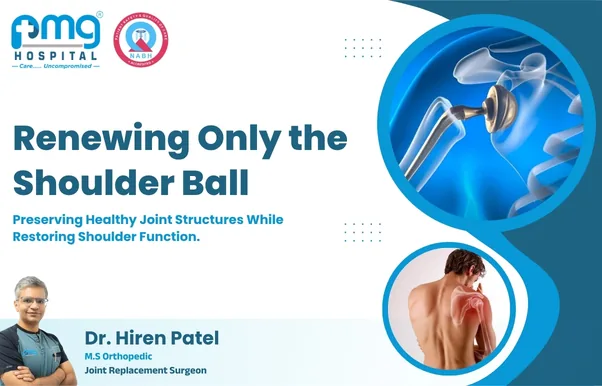
- Only the damaged humeral head resurfaced
- Suited to early arthritis and some fractures
- Preserves the natural glenoid socket
- Shorter procedure, less extensive rehabilitation
What is partial shoulder replacement?
Partial shoulder replacement (hemiarthroplasty) replaces only the ball at the top of the arm bone - the humeral head - with an artificial ball on a stem, while leaving your own socket (the glenoid) in place. Because only one side of the joint is replaced, less bone is disturbed and more of the natural shoulder, including the rotator cuff attachment, is preserved than in a total replacement. It is the right choice specifically when the ball is damaged but the socket is still healthy.
Who is a candidate for partial shoulder replacement?
Partial shoulder replacement is best suited to patients with early-stage arthritis confined to the humeral head, or a proximal humerus fracture, where the glenoid socket and rotator cuff remain in reasonable condition. When the socket itself is also significantly worn, a total shoulder replacement gives a more reliable long-term result, so the decision is confirmed on X-rays and an MRI before surgery.
Partial vs total shoulder replacement
The two operations treat different degrees of damage. A partial replacement resurfaces only the ball and keeps the natural socket; a total replacement resurfaces both surfaces and is used when arthritis involves the whole joint.
| Partial (hemiarthroplasty) | Total shoulder replacement | |
|---|---|---|
| What is replaced | Only the ball (humeral head) | Both the ball and the socket |
| Best suited to | Early arthritis of the ball, or fracture, with a healthy socket | Arthritis affecting the whole joint |
| Bone preserved | More natural bone and cuff attachment kept | More of the joint resurfaced |
| Rehabilitation | Shorter, less intensive | More structured and gradual |
For a whole-joint problem, see total shoulder replacement; for the full range of options, read the shoulder replacement overview.
How partial shoulder replacement surgery is performed
Under general anaesthesia with a nerve block, the damaged head of the arm bone is removed and replaced with an artificial ball on a stem, sized and positioned to match your own anatomy. Because the natural socket is left untouched, less bone is disturbed than in a total replacement, which is part of why the procedure is shorter and the early recovery is gentler. The arm is supported in a sling before you leave theatre.
Recovery after partial shoulder replacement
Hospital stay is typically two to three days. Rehabilitation is usually shorter and less intensive than after a total shoulder replacement, with the arm supported in a sling early on and a gradual return to daily activities over the following weeks as strength and range of motion improve. As with any shoulder surgery, gentle movement begins early and stronger active exercises are added in phases so a healing repair is not stressed too soon.

- Experience
- 14+ years
- Surgeries
- 14,000+
Partial shoulder replacement specialist in Ahmedabad
Choosing the right partial shoulder replacement doctor or hospital in Ahmedabad matters, because the result depends on careful candidate selection; hemiarthroplasty only works well when the socket and rotator cuff are genuinely healthy. Dr. Hiren Patel completed a dedicated international fellowship in Sports Medicine & Shoulder Surgery at St. Mary's Catholic Hospital, Seoul, South Korea, alongside 14+ years of orthopaedic practice and 14,000+ surgeries at PMG Hospital, Gota. As a shorter operation than a total replacement, a partial replacement is usually lower in cost, and a written estimate is provided before admission. Learn more about Dr. Hiren Patel.
Frequently asked questions
When is partial shoulder replacement preferred over total?
It is preferred when arthritis is confined to the ball (humeral head) and the socket and rotator cuff are still in good condition, or for certain proximal humerus fractures. It is a shorter, more bone-preserving operation. When the socket is also worn, a total replacement gives a more reliable long-term result.
How long is recovery after partial shoulder replacement?
Hospital stay is usually two to three days, and rehabilitation is shorter and less intensive than after a total replacement. The arm is supported in a sling early on, with a gradual return to daily activities over the following weeks as strength and movement improve.
Can a partial shoulder replacement be converted to total later?
Yes. If arthritis later affects the glenoid socket and pain returns, a partial replacement can usually be revised to a total or reverse shoulder replacement. Preserving bone at the first operation helps make that conversion more straightforward if it is ever needed.
Is partial shoulder replacement suitable for a shoulder fracture?
Yes. A partial replacement is one of the established options for a proximal humerus fracture - a break at the top of the arm bone - that is too damaged to fix reliably, provided the socket remains healthy. The broken head is replaced while the natural socket is kept.