
Hip Arthroscopy surgeon in Ahmedabad, Gujarat
Resolving Hip Impingement and Labral Tears
Groin pain in a young adult is too often labelled a muscle pull. Frequently it is femoroacetabular impingement (FAI) - an extra ridge of bone catching against the socket and tearing the labrum. Keyhole hip surgery can fix the mechanics before the joint wears out. Dr. Hiren Patel performs hip arthroscopy surgery in Ahmedabad to preserve the joint and delay - sometimes to avoid - a future replacement, at PMG Hospital, Gota.
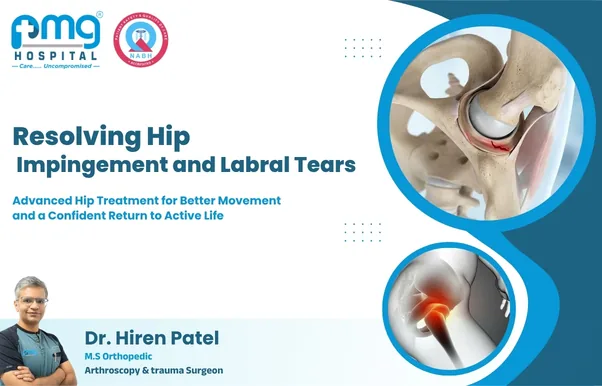
- Two small portals, no muscle detachment
- Labral repair rather than removal
- Cam and pincer bone reshaping
- Preserves the joint and delays replacement
What is hip arthroscopy?
Hip arthroscopy is keyhole surgery on the hip joint, done through two small portals with a camera and fine instruments rather than a large open incision. Its main use in young and active adults is to treat femoroacetabular impingement - where an extra bump of bone on the ball (a cam) or an over-covering rim of the socket (a pincer) repeatedly catches and tears the labrum, the cartilage seal around the socket. By reshaping that bone and repairing the labrum, the surgery corrects the underlying mechanics, which is why it is called hip preservation: it treats the cause before the cartilage wears down into arthritis.
Symptoms that point to a hip labral problem
The pattern is often mistaken for a groin strain that never quite settles. The clues are:
- Deep groin pain, often shown by cupping the hip with a C-shaped grip (the "C-sign")
- Pain sitting for long periods, driving, or getting out of a car
- Clicking or catching when the hip rotates
- Stiffness putting on socks or sitting cross-legged
What the surgery involves
Through two keyhole portals, the torn labrum is repaired with anchors, inflamed tissue is cleared, and the impinging cam or pincer bone is reshaped so the ball moves freely inside the socket. The emphasis is on repairing the labrum rather than simply trimming it away, because the labrum seals and protects the joint. Because no muscle is cut, pain after surgery is far less than with open hip procedures, and most patients go home the same day or the next morning.
Recovery
Crutches are used for two to four weeks with rotation restricted at first to protect the repair. A structured physiotherapy programme then restores hip control over about three months, and most sporting patients return to their sport between four and six months. Because the operation preserves the joint, recovery is aimed not just at getting back to activity but at keeping the hip healthy for the long term. Patients travel from Surat, Vadodara, Rajkot and Gandhinagar, as well as across Ahmedabad, for this joint-preserving option before the hip is damaged enough to need replacement.

- Experience
- 14+ years
- Surgeries
- 14,000+
Hip arthroscopy specialist in Ahmedabad
Hip arthroscopy is a specialised, technically demanding procedure, and its value depends on selecting the right patient - a young hip with impingement and a repairable labrum, before arthritis has set in - and on repairing rather than removing the labrum. Dr. Hiren Patel is an orthopaedic surgeon in Ahmedabad with 14+ years of practice and 14,000+ surgeries at PMG Hospital, Gota, and an international fellowship in Sports Medicine & Shoulder Surgery, offering hip arthroscopy for FAI and labral tears as a joint-preserving alternative to waiting for a replacement. Learn more about Dr. Hiren Patel, or read about hip replacement where the joint is already worn.
Frequently asked questions
Is hip arthroscopy suitable if I already have arthritis?
Generally no. Hip arthroscopy works best in a young hip with impingement and a repairable labrum but healthy cartilage - its whole purpose is to act before arthritis develops. Once the joint has significant arthritis, arthroscopy tends to give poor and short-lived relief, and a hip replacement usually gives a far more reliable result. Imaging is used to judge exactly where a hip sits on that line.
How is FAI diagnosed?
It starts with the pattern of groin pain and specific hip movement tests that reproduce the impingement. X-rays show the extra cam or pincer bone and the shape of the socket, and an MRI - often with contrast in the joint - shows the labral tear and the state of the cartilage. Sometimes a diagnostic injection into the joint is used to confirm the hip is truly the source of the pain.
Will the pain come back after surgery?
For a well-selected hip - impingement with a repairable labrum and good cartilage - reshaping the bone and repairing the labrum corrects the cause, and the results are durable in most patients. Pain is more likely to return if there was already cartilage wear at the time of surgery, which is exactly why treating the problem early, before arthritis, matters so much.
How long is recovery after hip arthroscopy?
Crutches are used for two to four weeks, hip control is rebuilt with physiotherapy over about three months, and sporting patients typically return between four and six months. The timeline depends on what was done - a labral repair with bone reshaping is protected for longer than a simple clean-up.
Consult a hip arthroscopy surgeon in Ahmedabad
If you are a young or active adult with deep groin pain that has been dismissed as a muscle pull - especially with clicking, or pain sitting and driving - bring any X-rays or MRI reports and current medicines to the clinic in Gota. You will be told plainly whether it is impingement and a labral tear, and whether hip arthroscopy would preserve the joint.
PMG Hospital, 3rd Floor, Athena Avenue, B/H Jaguar Showroom, Nr. Eulogia Inn Hotel, Gota, Ahmedabad, Gujarat · Mon-Sat: 10:00 AM - 8:00 PM · Sunday: By appointment
This page is for general education and is not a substitute for a consultation. Treatment, timelines and costs are decided individually after examination and imaging.