
Meniscus Tear Treatment & surgeon in Ahmedabad, Gujarat
Repairing a Torn Meniscus
The meniscus is the shock absorber between your thigh bone and shin bone. Tears happen from a twist in sport, or from simple squatting in patients over forty whose meniscus has degenerated. A knee without its meniscus develops arthritis far sooner. Dr. Hiren Patel treats meniscus tears in Ahmedabad arthroscopically, repairing the meniscus wherever the biology allows rather than simply removing it, at PMG Hospital.
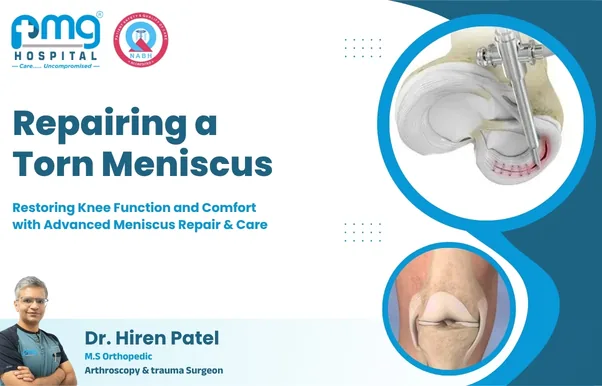
- Repair preferred over removal wherever biology allows
- All-inside suture techniques
- Immediate relief of a locked knee
- Root repair for degenerative extrusion
Symptoms of a meniscus tear
A torn flap of meniscus behaves like a stone in a hinge; it catches, locks and swells the joint. The common signs are:
- Pain on the inner or outer side of the joint line
- Clicking, catching, or the knee locking in a bent position
- Swelling a day after activity rather than immediately
- Pain on deep squatting, sitting cross-legged or using Indian-style toilets
Repair versus trimming
The single most important decision is whether the meniscus can be saved, because keeping it protects the knee from early arthritis. Tears in the outer third have a good blood supply and are stitched with all-inside implants so the meniscus heals and keeps working as a shock absorber. Tears in the inner, blood-poor zone cannot heal, so only the unstable flap is trimmed, preserving as much of the rim as possible. Meniscus root tears - increasingly recognised in Indian patients over 45 - are repaired back to bone, because a detached root behaves almost like having no meniscus at all and leads to rapid arthritis if left alone.
After surgery
Recovery depends on whether the meniscus was trimmed or repaired. After trimming, most patients walk the same day and return to desk work within a week. After a repair, weight-bearing and deep bending are restricted for four to six weeks to let the stitched tissue heal, with a return to sport at four to six months. The trade-off is deliberate: a repair asks for more patience but protects the knee for the long term. Meniscus repair and root-repair techniques are offered to patients from across Gujarat, including those referred from Surat, Vadodara and Rajkot after a locked knee was missed on a plain X-ray.

- Experience
- 14+ years
- Surgeries
- 14,000+
Meniscus specialist in Ahmedabad
Saving a meniscus rather than removing it takes judgement and technique - reading the tear pattern, knowing which tears will heal, and using all-inside and root-repair methods where they apply. Dr. Hiren Patel is an orthopaedic surgeon in Ahmedabad with 14+ years of practice and 14,000+ surgeries at PMG Hospital, Gota, and an international fellowship in Sports Medicine & Shoulder Surgery, with a repair-first approach to meniscus tears. A locked knee is often relieved in the same sitting. Learn more about Dr. Hiren Patel, or see related cartilage restoration and ACL reconstruction.
Frequently asked questions
Will a meniscus tear heal with rest and medicine?
Some do. A small tear in the outer rim, which has a blood supply, or a mild degenerative tear can settle with rest, ice, activity change and physiotherapy over about four to eight weeks. But a tear that locks or catches the knee, or one in the inner blood-poor zone, will not heal on its own and needs surgery - and ignoring it can wear the cartilage and bring on arthritis sooner.
Do I need surgery for a torn meniscus?
Not always. Small, stable tears and many degenerative tears are managed without surgery. Surgery is advised when the knee locks or catches, when pain and swelling persist despite rest and physiotherapy, or when the tear is one that can be repaired to save the meniscus - because preserving the meniscus protects the knee from early arthritis.
What is the difference between meniscus repair and trimming?
A repair stitches the torn meniscus back together so it heals and keeps working as a shock absorber, and is preferred wherever the tear's location and blood supply allow. Trimming (partial meniscectomy) removes only the unstable torn flap when the tissue cannot heal, keeping as much rim as possible. Repair protects the knee better in the long run but needs a longer, more protected recovery.
How long is recovery after meniscus surgery?
It depends on which was done. After trimming, most patients walk the same day and return to desk work within a week, with normal activity over four to eight weeks. After a repair, weight-bearing and deep bending are restricted for four to six weeks while the stitched tissue heals, with a return to sport at four to six months.
Is meniscus surgery day-care?
Yes. Meniscus surgery is done arthroscopically through keyhole incisions and is usually a day-care procedure, so most patients go home the same day. A repair simply needs a more protected recovery afterwards than a trim.
Can I sit cross-legged after meniscus surgery?
Eventually, yes - but not straight away, especially after a repair. Deep bending, squatting and sitting cross-legged are restricted for four to six weeks after a repair to protect the healing stitches, then reintroduced gradually; after a trim they return sooner. Because floor-sitting and squatting are part of daily life here, this is planned into your recovery.