
PCL Injury & Reconstruction surgeon in Ahmedabad, Gujarat
Managing a Torn PCL Ligament
The posterior cruciate ligament (PCL) is the strongest ligament in the knee, and is usually injured by a direct blow to the front of a bent knee, the classic dashboard injury on Ahmedabad's roads, or a fall onto the knee during sport. Dr. Hiren Patel grades and treats PCL injuries in Ahmedabad, from brace-led rehabilitation for most isolated tears to arthroscopic reconstruction for high-grade instability, at PMG Hospital.
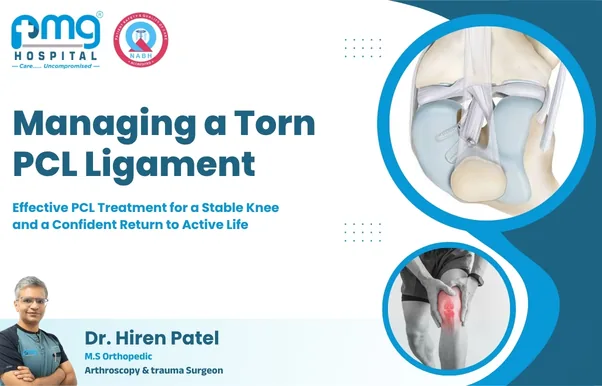
- Accurate grading with stress X-rays and MRI
- Many isolated tears treated without surgery
- Arthroscopic reconstruction for high-grade instability
- Dedicated PCL brace protocol
How a PCL tear feels
PCL injuries are quieter than ACL tears. Instead of a dramatic giving way, you tend to notice a vague deep ache, difficulty walking downhill or down stairs, and a knee that feels unreliable when slowing down. Because the signs are subtle, PCL tears are often missed at first. The common features are:
- Pain behind the knee, worse when kneeling
- Swelling that is often mild compared with the injury
- Difficulty with stairs, slopes and squatting
- Long-term kneecap pain if the injury is left untreated
Treatment: not every PCL tear needs surgery
The right treatment depends on the grade of the tear and whether other ligaments are involved, which is why accurate grading with stress X-rays and an MRI comes first. Isolated grade I and II tears usually recover well without surgery, using a dynamic PCL brace and an aggressive quadriceps-strengthening programme over three to four months. Grade III tears, combined ligament injuries, and knees that stay unstable after rehabilitation are reconstructed arthroscopically, using a single- or double-bundle graft technique to rebuild the ligament.
Recovery
PCL rehabilitation is slower and more protective than ACL rehabilitation, because a pull from the hamstrings can stretch a healing graft. Bracing continues for several weeks, with gradually progressive loading, and return to sport typically comes at nine to twelve months after reconstruction. A low-grade tear treated in a brace recovers more quickly, usually over a few months. Patients from Gandhinagar, Nadiad, Anand and other parts of Gujarat are followed up jointly with local physiotherapists where distance makes weekly clinic visits difficult.
- Experience
- 14+ years
- Surgeries
- 14,000+
PCL reconstruction surgeon in Ahmedabad
The PCL is injured far less often than the ACL, sits deep at the back of the knee near important nerves and vessels, and needs careful grading to decide between bracing and surgery - so it benefits from a surgeon experienced in knee ligament work. Dr. Hiren Patel is an orthopaedic surgeon in Ahmedabad with 14+ years of practice and 14,000+ surgeries at PMG Hospital, Gota, and an international fellowship in Sports Medicine & Shoulder Surgery, treating PCL injuries from brace-led rehabilitation to single- and double-bundle reconstruction. Learn more about Dr. Hiren Patel, or see related ACL reconstruction and knee trauma surgery.
Frequently asked questions
Can I walk with a torn PCL?
Often, yes. PCL injuries are quieter than ACL tears - instead of the knee giving way you feel a deep ache and find walking downhill or down stairs difficult, but many people can still walk soon after the injury. That does not mean it should be ignored, as an untreated PCL tear can lead to long-term kneecap and inner-knee pain.
Does a PCL tear always need surgery?
No. Most isolated grade I and II tears recover well without surgery, with a dynamic PCL brace and an aggressive quadriceps-strengthening programme over three to four months. Surgery is reserved for grade III tears, combined ligament injuries, or a knee that stays unstable despite rehabilitation.
Is PCL surgery more difficult than ACL surgery?
Generally, yes. The PCL sits deep at the back of the knee near important nerves and vessels, is injured far less often, and its rehabilitation is slower and more protective - so PCL reconstruction is more demanding and benefits from a surgeon experienced in ligament work.
How long does the PCL brace need to be worn?
The dynamic PCL brace is usually worn for several weeks, both in non-surgical treatment and after reconstruction, because it supports the healing ligament or graft and counteracts the backward sag of the shin bone. Your surgeon adjusts the duration to the grade of injury and your progress.
How long is recovery after PCL surgery?
Recovery is slower than after ACL surgery. Bracing continues for several weeks with progressive loading, and return to sport is typically at nine to twelve months, once strength and stability are restored. A low-grade tear treated in a brace recovers more quickly, usually over a few months.
Will I be able to return to sport after a PCL injury?
Most patients return to sport, whether treated with a brace and rehabilitation or with reconstruction, provided the programme is completed. The timeline depends on the grade of the injury and whether other ligaments were also involved.