
Rotator Cuff Repair surgeon in Ahmedabad, Gujarat
Repairing a Torn Rotator Cuff
A torn rotator cuff makes lifting the arm painful and weak, and typically wakes you at night when you roll onto the shoulder. Dr. Hiren Patel performs rotator cuff surgery in Ahmedabad arthroscopically through small keyhole incisions, reattaching the tendon to the bone with anchors, at PMG Hospital.
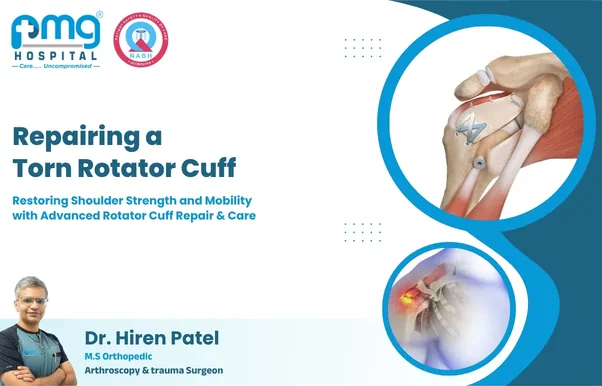
- Keyhole repair through small incisions
- Tendon reattached with suture anchors
- For night pain, weakness and overhead difficulty
- Phased rehabilitation protecting the repair
What is the rotator cuff?
The rotator cuff is a group of four muscles and their tendons that wrap around the top of the arm bone and hold it centred in the shallow shoulder socket. They are what lift and rotate the arm, and what keep the joint stable while you do it. A tear means one of those tendons has pulled away from the bone - either suddenly, after a fall or a heavy lift, or gradually, as the tendon wears with age. A gradual tear often starts as a partial one and enlarges over time, which is why a shoulder that has ached for months can suddenly become much weaker.
Symptoms of a rotator cuff tear
The pattern is usually recognisable, and it is what prompts most patients to seek help:
- Pain on the outer shoulder and upper arm, worse reaching overhead
- Night pain, particularly lying on the affected side
- Weakness lifting the arm or holding it out to the side
- Difficulty with everyday tasks such as combing hair or reaching a shelf
- A catching or grating sensation as the arm moves
Who needs surgical repair
Not every tear needs surgery. A partial tear, or a small tear in an older, less demanding shoulder, often settles with physiotherapy to strengthen the surrounding muscles, activity modification and sometimes an injection. Repair is recommended when a full-thickness tear follows an injury in an active patient, when weakness limits daily life, or when pain persists despite a proper course of non-surgical treatment.
Timing matters for a tear caused by an injury: a torn tendon retracts and its muscle gradually degenerates, and a repair done before that happens holds better and works better. An MRI confirms the size and position of the tear, and the quality of the muscle, before the decision is made.
How arthroscopic rotator cuff repair is performed
The repair is done arthroscopically under general anaesthesia with a nerve block, through several small incisions rather than a large open one. A camera is placed inside the joint, the torn tendon edge is identified and freed, and the bone where it should attach is prepared. Small anchors are then inserted into the bone, and the sutures attached to them are used to pull the tendon back down onto its footprint and hold it there while it heals.
Any associated problems are dealt with in the same sitting - a bone spur rubbing on the tendon is trimmed, an inflamed bursa removed, and a damaged biceps tendon or labral tear treated if present. Most patients go home the same day or the next.
Recovery after rotator cuff repair
A repaired tendon takes around three months to heal onto bone, and the rehabilitation is built entirely around protecting it. The arm is supported in a sling for four to six weeks, with the physiotherapist moving the shoulder passively during that time to prevent stiffness. Active movement is added once the sling comes off, and strengthened only after about three months.
Pain usually improves well before strength does. Most patients manage daily tasks comfortably by three to four months, with full strength and confident overhead use continuing to return over six to twelve months. Pushing active movement early is the commonest cause of a repair failing, so the phased programme matters as much as the operation.
- Experience
- 14+ years
- Surgeries
- 14,000+
Rotator cuff repair specialist in Ahmedabad
Shoulder arthroscopy is technically distinct from knee work, so specific shoulder training matters. Dr. Hiren Patel completed a dedicated international fellowship in Sports Medicine & Shoulder Surgery at St. Mary's Catholic Hospital, Seoul, South Korea, alongside 14+ years of orthopaedic practice and 14,000+ surgeries at PMG Hospital, repairing rotator cuff tears arthroscopically and addressing any bone spur, bursa or biceps problem in the same sitting. Learn more about Dr. Hiren Patel, or read about shoulder replacement where a cuff tear has already damaged the joint.
Frequently asked questions
Does every rotator cuff tear need surgery?
No. Partial tears and small tears in less demanding shoulders often settle with physiotherapy, activity changes and sometimes an injection. Surgery is recommended for a full-thickness tear after an injury in an active patient, for weakness that limits daily life, or when pain persists despite proper non-surgical treatment.
How long will I be in a sling?
Usually four to six weeks. During that time the physiotherapist moves the shoulder passively to prevent stiffness while the tendon heals onto the bone, and you begin active movement only once the sling comes off. The exact duration depends on the size of the tear and the strength of the repair.
Can a repaired rotator cuff tear again?
Yes, a repaired cuff can re-tear, most often when active movement is pushed too early, when the original tear was large, or when the tendon quality was poor. Following the phased, sling-protected rehabilitation and not loading the shoulder before it is ready is the single best way to protect the repair.
Why is the pain worse at night?
Night pain is one of the most characteristic features of a rotator cuff tear. Lying down removes the support that holds the arm through the day, and rolling onto the shoulder loads the inflamed, torn tendon directly, so the ache intensifies and often disturbs sleep. It is one of the commonest reasons patients finally seek treatment.