
Robotic Excellence - ROSA Knee Replacement Surgeon in Ahmedabad, Gujarat
Knee Renewal Using the ROSA Robotic System
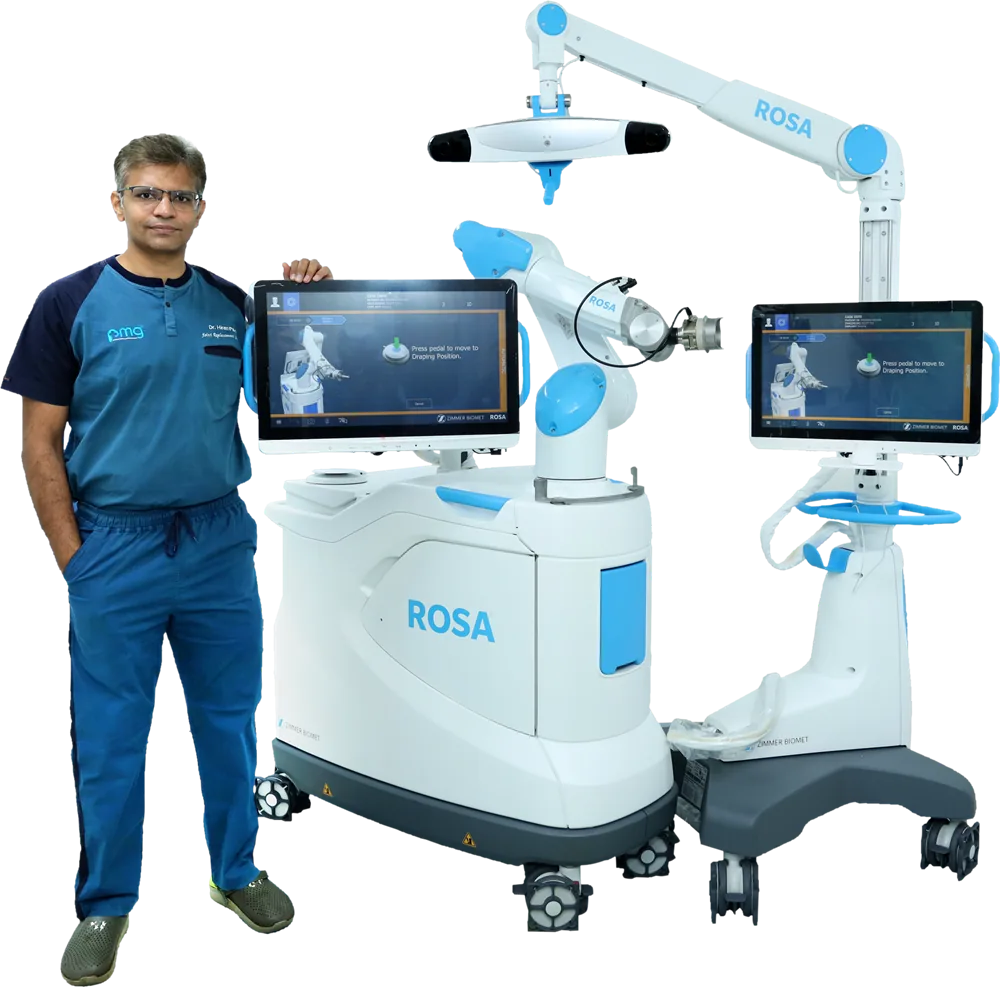
Robotic assistance lets a knee replacement be planned and carried out to a level of precision that manual instruments alone cannot match. At PMG Hospital, Dr. Hiren Patel combines the ROSA robotic system with a muscle-sparing surgical approach and tourniquet-less technique, so the knee is not only accurately aligned but also recovers more comfortably. Importantly, the robot is a tool the surgeon controls - it guides, it does not operate on its own.
- ROSA robotic precision in alignment and balance
- Subvastus muscle-sparing approach
- Tourniquet-less surgery for a gentler recovery
- Patient-specific plan built before the first cut

What is TriNova Knee Replacement?
TriNova is the name for the knee replacement approach used here, bringing together three elements that each address a different part of the operation - precision, the surgical approach, and blood-flow management. Combined, they aim for an accurately positioned implant and a smoother early recovery.
Robotic assistance
The ROSA robotic system builds a patient-specific plan and then gives the surgeon real-time measurements during surgery, so the bone cuts, implant position and alignment follow the plan precisely. The surgeon makes every decision and performs the operation; the robot supplies the data and guidance that make it more reproducible.
Subvastus approach
Conventional knee replacement usually reaches the joint by cutting through the quadriceps tendon. The subvastus approach instead goes beneath the quadriceps muscle, leaving the extensor mechanism intact. Because the muscle that straightens the knee is not divided, patients typically regain a straight-leg raise sooner and have less early pain.
Tourniquet-less surgery
Knee replacement is traditionally done with a tight thigh tourniquet to reduce bleeding. Performing it without a tourniquet - using tranexamic acid and careful control of bleeding instead - avoids the thigh-muscle pain, bruising and temporary weakness a tourniquet can cause, which supports a quicker, more comfortable early recovery.
How ROSA works
Robotic assistance follows four steps, from planning to the operation itself.
Step 1
Imaging
Pre-operative X-rays of the leg are captured and used to understand the exact shape, angles and deformity of your knee.
Step 2
Digital modelling
Those images are converted into a three-dimensional digital model of your knee, unique to you.
Step 3
Surgical planning
On that model, the surgeon plans the size, position and alignment of the implant precisely before the operation begins and can adjust the plan to your particular anatomy.
Step 4
Real-time guidance
During surgery, the system tracks the knee and provides live measurements of alignment and soft-tissue balance as the knee is moved, so the plan can be fine-tuned and the bone cuts made accurately. The surgeon carries out each step guided by that data.
Why robotic assistance matters
The two things that most determine how a replaced knee feels and how long it lasts are its alignment and its soft-tissue balance - whether the leg is straight and the knee is neither too tight nor too loose through its range. Manual instruments rely on the surgeon's eye and jigs; robotic assistance measures both directly and continuously, which is designed to improve the accuracy and consistency of the result and to preserve healthy bone and soft tissue by cutting only what the plan requires.
It is fair to be balanced about this: knee replacement gives excellent results in experienced hands with or without a robot, and the surgeon's judgement remains central. Robotic assistance is most valuable where precision is hardest to achieve manually - significant deformity, or a knee with previous hardware - and Dr. Hiren Patel brings 14+ years of practice and 14,000+ surgeries, with an international fellowship in joint replacement, to that planning.
Medically reviewed by Dr. Hiren Patel, MBBS, MS (Ortho), International Fellowship in Joint Replacement.
ROSA robotic vs conventional knee replacement
The difference is in how alignment and balance are achieved, not in the implant itself.
| Aspect | ROSA robotic-assisted | Conventional (manual) |
|---|---|---|
| Planning | Patient-specific 3D plan before surgery | Based on standard jigs and surgeon judgement during surgery |
| Alignment | Guided by live measurements | Set with mechanical jigs and visual assessment |
| Soft-tissue balance | Measured through the range of movement | Judged by feel and experience |
| Bone and tissue | Only what the plan requires is removed | Removed using standard cutting guides |
| Best advantage | Complex deformity, previous hardware, reproducibility | Reliable, time-proven, effective in experienced hands |
Are you a candidate for robotic knee replacement?
Almost anyone who needs a first-time knee replacement for arthritis is also a candidate for the robotic-assisted procedure. It is particularly useful where the knee has significant deformity, or where previous surgery or a healed fracture has left hardware in place, because it can plan around these accurately. It is used more selectively for revision (redo) replacements. Whether it is the right choice for you is decided individually after examination and imaging - the goal is always a well-aligned, well-balanced knee, by whatever route achieves that best for your knee.
Available across Ahmedabad and Gujarat
Robotic knee replacement at PMG Hospital is within easy reach of Satellite, Vastrapur, Thaltej, Bopal and Gandhinagar, and serves patients travelling from across Gujarat - Nadiad, Mehsana, Anand, Surat, Vadodara and Rajkot. Patients from outside Ahmedabad are given a clear pre-operative plan and a rehabilitation programme they can continue with a local physiotherapist between reviews.
Frequently asked questions
Does a robot perform a knee replacement?
No. This is robotic-assisted surgery: the surgeon plans the operation, makes every decision, and performs it. The robot does not act on its own; it provides a patient-specific plan and real-time measurements that help the surgeon place the implant accurately. The human surgeon remains fully in control throughout.
Is robotic knee replacement better than conventional surgery?
Robotic assistance improves the accuracy of alignment and soft-tissue balancing and preserves bone and tissue, and it can support a smoother early recovery. That said, knee replacement gives excellent results in experienced hands either way, so the honest position is that robotic assistance is a valuable tool - most clearly so in complex knees - rather than a guarantee of a better outcome for every patient.
Does robotic knee replacement cost more?
The robotic technology can add to the cost of the procedure, and sometimes to the pre-operative imaging. The exact difference depends on the hospital package and your insurance, and a written, itemised estimate is provided before admission so you can weigh it up. No figure is quoted here because it is set individually.
Is robotic knee replacement safe?
Yes. It uses the same well-established implants as conventional knee replacement, with the robot adding planning and guidance rather than changing the fundamental operation. Placing the tracking pins requires two small extra points on the bone. As with any major surgery there are risks, which are explained to you beforehand.