
Total Hip Replacement Surgeon in Ahmedabad, Gujarat
Renewing the Hip Ball and Socket
Total hip replacement replaces both the ball (femoral head) and the socket (acetabulum) of a severely damaged hip joint with artificial implants to relieve pain and restore movement. Dr. Hiren Patel is a total hip replacement surgeon in Ahmedabad with 14+ years of experience and 14,000+ surgeries, performing total hip replacement at PMG Hospital, for arthritis, avascular necrosis and hip fracture with implant options matched to your age, bone quality and activity level.
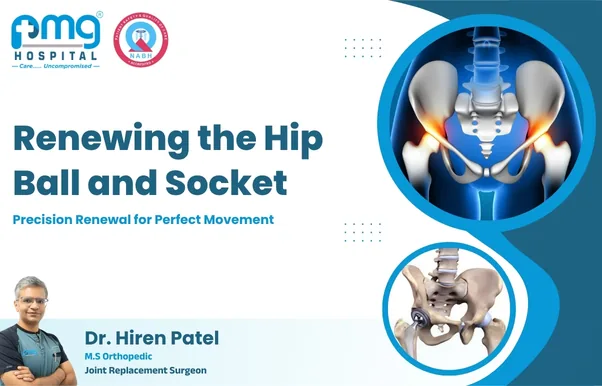
- Both ball and socket resurfaced
- Ceramic-on-polyethylene and ceramic-on-ceramic options
- For arthritis, AVN and hip fracture
- Implants typically last 15–20 years or more
What is total hip replacement?
Total hip replacement (total hip arthroplasty) replaces the whole ball-and-socket joint: the worn femoral head is removed and replaced with an artificial ball on a stem set into the thigh bone, and the damaged socket is resurfaced with a cup and a low-friction liner. Together they recreate the smooth, gliding movement of a healthy hip. It differs from a partial replacement, which resurfaces only the ball; total replacement is the right choice when the arthritis or damage involves the whole joint rather than just the femoral head.
Who needs total hip replacement?
Total hip replacement is considered once medicines, physiotherapy or injections no longer control hip pain and stiffness, and daily life is affected. A clinical examination and X-rays confirm whether replacement is genuinely needed. The common reasons are:
- Osteoarthritis of the hip
- Avascular necrosis (AVN) of the femoral head
- Rheumatoid and inflammatory arthritis
- Hip fracture in older patients
- A failed previous hip surgery or a loose implant
How total hip replacement surgery is performed
Under spinal or general anaesthesia, the damaged femoral head is removed and the socket is reamed down to healthy bone. A stem is placed into the thigh bone - press-fit or cemented depending on bone quality - and an artificial ball and cup are fitted to recreate the joint, which is checked for stability and leg length before closure. Restoring leg length and offset accurately is one of the most important steps, because it is what lets you walk without a limp afterwards. Physiotherapy to rebuild strength and mobility begins soon after surgery.
Total hip replacement implant options and longevity
The bearing surface - the ball and liner that move against each other - is chosen by the surgeon to suit your age, bone quality and activity level. Ceramic-on-polyethylene is a reliable, widely used combination across age groups, while ceramic-on-ceramic offers the lowest wear for younger, more active patients. Fixation may be cemented, favoured for softer or osteoporotic bone, or uncemented (press-fit), where bone grows onto a textured surface in patients with good bone stock. A total hip replacement typically lasts 15 to 20 years or more, with roughly 90% still working well at fifteen years; excessive wear or loosening can eventually need revision surgery. A costlier bearing is not automatically the right one - accurate sizing, positioning and an infection-free procedure matter more than the price of the implant.
Total vs partial hip replacement
Total hip replacement resurfaces both the ball and the socket and suits arthritis or damage affecting the whole joint. A partial hip replacement (hemiarthroplasty) replaces only the femoral head and is used mainly for a femoral-neck fracture in an older patient where the socket is still healthy. Which one fits is decided on your X-rays and the state of the socket. For the fuller picture across all hip procedures, see the hip replacement overview.
Recovery after total hip replacement
Most patients walk with support within days of surgery and go home in three to five days. A stick usually replaces the walker by two to three weeks, driving resumes at about four to six weeks, and walking feels normal by around three months, with full strength returning over six to twelve months. Because the hip can dislocate while the tissues heal, movement precautions - no deep bending past 90°, no crossing the legs, no twisting the operated leg inward - are followed for the first six weeks and relaxed in stages on your surgeon's advice. A structured physiotherapy programme, especially hip-abductor strengthening, is what restores a steady, limp-free walk.
Total hip replacement cost in Ahmedabad
Total hip replacement in Ahmedabad generally costs between Rs 1.5 lakh and Rs 4.5 lakh, covering surgeon fees, implant, hospital stay, anaesthesia, consultations and post-surgery physiotherapy. The main variable is the implant and bearing type - ceramic-on-ceramic sits at the higher end, cemented metal-on-polyethylene at the lower. A written, itemised estimate is provided before admission, and most insurance policies cover the procedure once the joint-replacement waiting period is complete. Figures are indicative and confirmed in writing after your consultation.

- Experience
- 14+ years
- Surgeries
- 14,000+
Total hip replacement Doctor in Ahmedabad
Dr. Hiren Patel is a total hip replacement surgeon in Ahmedabad with 14+ years of practice and 14,000+ surgeries at PMG Hospital, Gota, including a dedicated international fellowship in hip arthroplasty at Balgrist University Hospital, Switzerland and the Galeazzi Institute of Orthopedics, Milan. When choosing a total hip replacement doctor or hospital in Ahmedabad, it helps to look for this kind of sub-specialised training, implant options explained clearly rather than sold from a price list, and a transparent written estimate. Learn more about Dr. Hiren Patel. Second opinions on a hip replacement already advised elsewhere are welcome.
Frequently asked questions
How long does a total hip replacement last?
A total hip replacement typically lasts 15 to 20 years or more, and joint registries report roughly 90% still working well at fifteen years. Longevity depends on the bearing surface, body weight and activity level, so younger, active patients may be advised a harder-wearing ceramic option.
What implant options are available?
Ceramic-on-polyethylene and ceramic-on-ceramic bearing surfaces are both used, with cemented or uncemented fixation. The choice is guided by your age, bone quality and activity level - ceramic-on-ceramic for younger, active patients and cemented fixation for softer, osteoporotic bone.
What does total hip replacement cost in Ahmedabad?
Total hip replacement in Ahmedabad generally costs between Rs 1.5 lakh and Rs 4.5 lakh, covering surgeon fees, implant, hospital stay, anaesthesia and physiotherapy. The main variable is the implant and bearing type. A written estimate is provided before admission, and most policies cover it once the waiting period is complete.
Can hip replacement treat a hip fracture?
Yes. A femoral-neck fracture in an older patient is treated with a hip replacement - either a total replacement or a partial one (hemiarthroplasty), depending on the health of the socket and the patient's activity level. Fractures are usually operated on promptly to avoid the risks of prolonged bed rest.
How is total hip replacement different from partial?
Total hip replacement resurfaces both the ball and the socket and suits arthritis affecting the whole joint. A partial replacement (hemiarthroplasty) replaces only the ball and is used mainly for a femoral-neck fracture where the socket is still healthy. Which one fits you is confirmed on X-rays.