
Partial Hip Replacement Surgeon in Ahmedabad, Gujarat
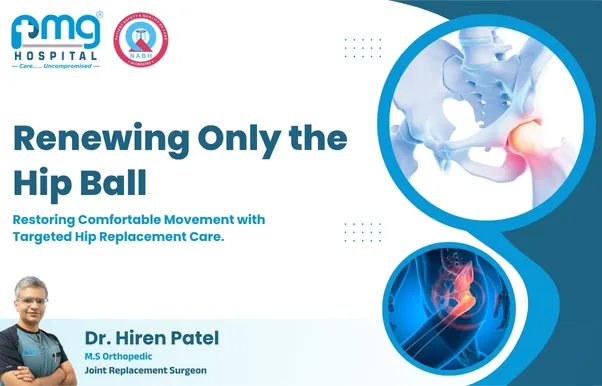
Renewing Only the Hip Ball
Partial hip replacement, also called hip hemiarthroplasty, replaces only the damaged ball (femoral head) and keeps your own socket. It is used most often for a displaced fracture of the neck of the thigh bone (the femoral neck) when the socket itself is healthy. As a shorter operation than a total hip replacement, it suits many older or less active patients.
At PMG Hospital, Gota, Ahmedabad, partial hip replacement is performed, and emergency and trauma care is available 24×7.
- Keeps your own hip socket
- Used mainly for a fracture of the neck of the thigh bone
- Unipolar or bipolar implant options
- Walking with a frame usually within a day or two
What Is Partial Hip Replacement?
Partial hip replacement (hemiarthroplasty) replaces only the femoral head, the ball at the top of the thigh bone, with an artificial ball on a stem, while leaving your own socket in place. Because only half of the joint is replaced, it is a smaller, shorter operation than a total hip replacement, which replaces both the ball and the socket. It is used when the ball is broken or damaged but the socket is still healthy.
Who Needs Partial Hip Replacement?
Partial hip replacement is mainly used for a displaced fracture of the neck of the thigh bone when the socket is still healthy. It suits many older or less active adults, for whom a shorter operation and getting moving again quickly matter most. When arthritis has already damaged the socket, a total hip replacement is usually chosen instead, because an arthritic socket left in place would keep causing pain.
Assessment Before Surgery
A partial hip replacement doctor in Ahmedabad — an orthopaedic surgeon who treats hip fractures — confirms the type of fracture and the condition of the socket on X-rays. A CT or MRI scan is sometimes needed when the fracture is not clear on X-rays.
Because most patients are older, the heart, lungs, kidneys, blood sugar, medicines (especially blood thinners) and general health are checked promptly, so that surgery can be done safely and without unnecessary delay.
Partial Hip Replacement Treatment in Ahmedabad: Options for a Hip Fracture
Partial hip replacement treatment in Ahmedabad is one of several options for a broken hip. The choice depends on where the bone is broken, whether the pieces have moved, the patient's age and activity level, and the condition of the socket:
- Fixation with screws: often for a fracture of the neck of the thigh bone that has not moved, and for most such fractures in younger patients, even when the pieces have moved
- Fixation with a nail, or a plate and screws: usually for fractures below the neck of the thigh bone
- Partial hip replacement (hemiarthroplasty): often for a displaced fracture of the neck of the thigh bone in an older patient with a healthy socket
- Total hip replacement: sometimes for more active patients, or when the socket already has arthritis
Surgery for a hip fracture is usually advised on the day of admission or the next day, once the patient is medically ready, because long bed rest in older people carries serious risks such as chest infection, blood clots and pressure sores.
How Partial Hip Replacement Surgery Is Performed
Under spinal or general anaesthesia, the broken ball is removed through an incision, and a metal stem is fitted into the thigh bone, with or without bone cement, topped with an artificial ball. The natural socket (acetabulum) is left in place, and physiotherapy begins soon afterwards.
The ball may be unipolar (a single head) or bipolar (with an extra bearing inside the head that allows movement within it); the bipolar design is intended to reduce wear on the natural socket. Studies comparing the two designs have not shown a clear difference in results.
Partial vs Total Hip Replacement
The two operations treat different problems. A partial replacement replaces only the ball and keeps the natural socket, and is used mainly for a fracture of the neck of the thigh bone. A total replacement replaces both the ball and the socket, and is used when arthritis or damage involves the whole joint.
| Feature | Partial (hemiarthroplasty) | Total hip replacement |
|---|---|---|
| What is replaced | Only the ball (femoral head) | Both the ball and the socket |
| Main use | Fracture of the neck of the thigh bone, with a healthy socket | Arthritis or damage to the whole joint; some fractures in more active patients |
| Operation | Shorter | Longer |
| Dislocation after a hip fracture | Less common | More common |
| Usually suited to | Older or less active patients | A wider range of patients and ages |
For hip fractures, studies comparing the two operations have found that any benefit of total hip replacement is likely to be small, and that dislocation is more common after total hip replacement; most other risks are similar.
Recovery After Partial Hip Replacement
Hospital stay is usually about three to six days, depending on the patient's general health. Physiotherapy begins almost immediately; many patients walk with a frame or walker within a day or two, because getting an older patient moving quickly after a hip fracture helps avoid the complications of long bed rest. Light activities return gradually over a few months. Some patients need longer, or continue to use a walking aid, especially if they were less mobile before the fracture.
Movement precautions are followed in the early weeks to reduce the risk of dislocation while the tissues heal, and are eased on the surgeon's advice. After a hip fracture, bone strength (for osteoporosis) is often checked, and ways to prevent further falls are discussed.
Risks and Possible Complications
Partial hip replacement is often done in older patients after a fracture, so general medical risks are an important part of the decision. The possible complications include:
- Infection of the wound or around the implant, which is uncommon but may need further surgery
- Dislocation of the new joint (the ball slipping out of the socket), which is most likely in the first few months
- Blood clots in the leg veins (deep vein thrombosis) or lungs (pulmonary embolism)
- A difference in leg length, which some patients notice
- Fracture of the bone around the implant during or after surgery
- Injury to nerves or blood vessels, such as the sciatic nerve, which is rare
- Numbness of the skin near the scar, including on the outer side of the thigh
- Continuing pain or a limp in some patients
- Wound problems, such as delayed healing or discharge
- Loosening and wear of the implant over time, which may need revision surgery
- Anaesthesia-related and general medical risks, such as heart, lung or kidney problems, especially in older patients or those with other illnesses
- Confusion (delirium) for a few days after surgery, which is common in older patients after a hip fracture
- Chest infection, urine infection or pressure sores, especially if getting moving is delayed
- Wear of the natural socket over time, which may cause pain and occasionally needs conversion to a total hip replacement
The surgeon explains the risks that apply to you before you decide on surgery.
Partial Hip Replacement Cost in Ahmedabad
The cost depends on:
- The implant type (unipolar or bipolar) and cemented or uncemented fixation
- Length of hospital stay and room category
- Tests before surgery and treatment of other medical conditions
- Medicines
- Physiotherapy and follow-up visits
A written, itemised estimate can be requested from the hospital after assessment.
Insurance
- Medically necessary partial hip replacement is generally covered under health insurance policies, subject to policy terms, waiting periods and insurer approval
- Some policies have limits on room rent or implant costs; check these with your insurer before surgery
- Ask the hospital whether cashless treatment is available with your insurer, and which documents are needed
How to Choose a Partial Hip Replacement Surgeon in Ahmedabad
When choosing a partial hip replacement surgeon in Ahmedabad, check that the surgeon is a qualified orthopaedic surgeon with valid medical council registration, that the procedure is performed regularly, how infection is prevented, which implants are used and why, how soon a hip fracture can be operated on, what physiotherapy and follow-up are provided, and what the written estimate includes.
Look beyond general phrases such as "partial hip replacement surgeon with modern facilities" and ask which facilities are actually available at the hospital where the treatment will be done.
Partial Hip Replacement Doctor in Ahmedabad
A broken hip that needs a partial replacement is treated by an orthopaedic surgeon, usually after the patient has first been seen in an emergency department. Because most patients are older and often have other illnesses, several doctors work together:
| Doctor or therapist | Role |
|---|---|
| Emergency doctor | Assesses the patient after the fall, gives pain relief, arranges X-rays and looks for other injuries |
| Orthopaedic surgeon | Confirms the fracture type and the state of the socket, chooses between fixation, partial replacement and total replacement, and operates |
| Physician or cardiologist | Checks the heart, lungs, kidneys, blood sugar and blood thinners so that surgery is not delayed without need |
| Anaesthetist | Chooses between spinal and general anaesthesia and adds a nerve block to ease pain around the time of surgery |
| Physiotherapist | Helps the patient stand and walk with a frame, and teaches the movements to avoid while the hip heals |
| Physician or endocrinologist | Checks bone strength for osteoporosis after the fracture and advises treatment to lower the chance of another break |
Partial Hip Replacement Surgery Doctor in Ahmedabad
A hip fracture usually needs a decision within a day or so, and families often have many questions at once. These are worth asking the partial hip replacement surgery doctor in Ahmedabad who is treating your relative:
- Can this fracture be fixed with screws, or does it need a replacement, and why?
- How soon can the operation be done, and which checks must be finished first?
- Will the stem be cemented into the bone or fixed without cement, and why?
- Do any regular medicines, especially blood thinners, affect the timing of surgery?
- Which movements should be avoided in the early weeks to protect the hip from dislocating?
- Will a walking aid be needed at home, and what changes would make the house safer against falls?
- Should bone strength be tested, and is treatment for osteoporosis needed?
- Whom should we contact after discharge if there is fever, wound discharge or sudden hip pain?
About the Treating Surgeon
At PMG Hospital, Gota, Ahmedabad, partial hip replacement is performed by:
| Detail | Information |
|---|---|
| Name | Dr. Hiren Patel |
| Qualification | MBBS, MS (Ortho), International Fellowship in Joint Replacement |
| Education | MBBS and MS (Ortho), B.J. Medical College, Ahmedabad |
| Specialty | Orthopaedics |
| Designation | Director & Head Joint Replacement Surgeon, PMG Hospital |
| Registration status | Registered Medical Practitioner |
| Registration number | Gujarat Medical Council Reg. No. G-20583 |
| OPD availability | Monday to Saturday, 10:00 AM – 8:00 PM; Sunday by appointment |
Facilities at PMG Hospital
- Orthopaedic OPD, Monday to Saturday; Sunday by appointment
- Emergency and trauma care, 24×7
- Orthopaedic physiotherapy
Frequently asked questions
What is the difference between partial and total hip replacement?
Partial replacement (hemiarthroplasty) replaces only the ball and keeps your natural socket, and is used mainly for a fracture of the neck of the thigh bone when the socket is healthy. Total replacement replaces both the ball and the socket and is used when arthritis affects the whole joint. Which one suits you is decided on your X-rays and the condition of the socket, together with your activity level and general health.
What is the difference between unipolar and bipolar hemiarthroplasty?
A unipolar implant has a single ball, while a bipolar implant has an extra bearing inside the head that allows movement within it, designed to reduce wear on the natural socket. Studies comparing the two have not shown a clear difference in results. The choice depends on the patient's age, activity level and the condition of the socket.
How long is the hospital stay?
Hospital stay is usually about three to six days, depending on the patient's general health. Physiotherapy starts almost immediately, and many patients walk with a frame or walker within a day or two, with light activities returning gradually over a few months.
What does partial hip replacement cost?
The cost differs from patient to patient. It depends on the implant type, the length of hospital stay and room category, tests and treatment of other medical conditions, medicines, and physiotherapy. A written, itemised estimate can be requested from the hospital after assessment.
Is partial hip replacement suitable for elderly patients?
Often, yes. It is commonly chosen for older or less active patients because it is a shorter operation than a total replacement, with a lower risk of dislocation, and it helps them get moving quickly after a fracture, reducing the risks that come with long bed rest. The patient's general health is checked carefully before surgery.
Contact and Location
PMG Hospital
3rd Floor, Athena Avenue, B/H Jaguar Showroom, Nr. Eulogia Inn Hotel, Gota, Ahmedabad, Gujarat
Phone / WhatsApp: +91 96627 70141
Email: pmghospital.ahm@gmail.com
OPD: Monday to Saturday, 10:00 AM – 8:00 PM; Sunday by appointment
Emergency and trauma care: 24×7
Medically reviewed by Dr. Hiren Patel, MS (Ortho.), Joint Replacement Surgeon, PMG Hospital, Ahmedabad.