
Knee, hip and shoulder replacement surgeon in Ahmedabad
Replacing a Worn Joint
Joint replacement is considered when arthritis has worn away the joint surface and pain controls your day: when stairs, temple steps, squatting and a full night's sleep are no longer possible. A replacement may relieve pain and improve movement.
At PMG Hospital, Gota, Ahmedabad, knee, hip and shoulder replacement are performed, including robotic-assisted knee replacement with the ROSA Knee System.
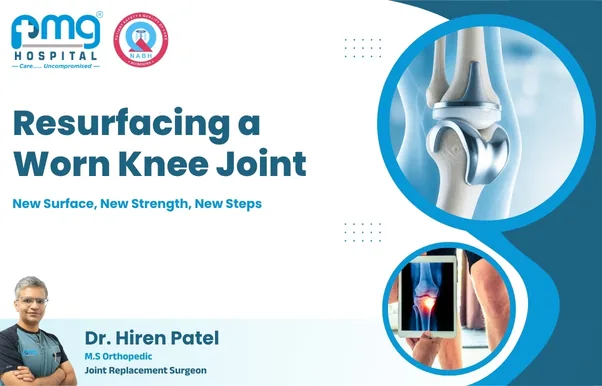
- Knee, hip and shoulder replacement
- Total, partial and revision procedures
- Robotic-assisted knee replacement (ROSA Knee System)
- Structured physiotherapy after every replacement
Types of Joint Replacement
| Page | What it covers |
|---|---|
| Knee Replacement | Total, partial, revision and robotic-assisted (TriNova) knee replacement |
| Hip Replacement | Total, partial and revision hip replacement for arthritis, avascular necrosis and some fractures |
| Shoulder Replacement | Conventional (anatomic) and reverse shoulder replacement for arthritis and some complex fractures |
| Total Knee Replacement | Replacement of all three compartments of a knee worn by arthritis |
| Partial Knee Replacement | Replacement of one worn compartment when the rest of the knee is healthy |
| Total Hip Replacement | Replacement of both the ball and the socket of the hip |
| Partial Hip Replacement | Replacement of only the ball of the hip, mainly after a fracture |
| Total Shoulder Replacement | Anatomic or reverse replacement, chosen according to the rotator cuff |
| Partial Shoulder Replacement | Replacement of only the ball of the shoulder when the socket is healthy |
| Revision Knee Replacement | Replacement of a loose, worn, unstable or infected knee implant |
| Revision Hip Replacement | Replacement of a loose, worn, unstable or infected hip implant |
| Revision Shoulder Replacement | Replacement of a loose, worn, unstable or infected shoulder implant |
| Knee Replacement Cost | What decides the cost: implant type, robotic assistance, room category and physiotherapy |
TriNova Knee Replacement
TriNova is the name used at PMG Hospital for a combination of three choices in knee replacement. They are used when they suit the individual knee, not for every patient.
| Part of TriNova | What it is | Points to consider |
|---|---|---|
| Robotic assistance (ROSA Knee System) | The knee is measured during surgery, and the cutting guide is positioned according to the plan; the surgeon makes the bone cuts | Studies have shown better implant alignment on X-rays after surgery; function scores and complications have been similar to conventional surgery so far, and long-term benefits are still being studied |
| Subvastus approach | The knee is opened beneath the vastus medialis muscle, instead of through the quadriceps tendon | Aims to reduce disturbance of the thigh muscle; any advantage is mainly in the first weeks, and it may not suit every knee |
| Surgery without a tourniquet | The operation is done without a tight cuff around the thigh, so blood flow to the leg is not stopped during the operation | May reduce thigh pain after surgery; there may be slightly more bleeding during surgery, and medicines to reduce bleeding are commonly used |
More on robotic knee replacement.
When Is the Right Time for Joint Replacement?
Replacement may be considered when night pain persists, walking distance has shrunk, painkillers are needed on most days, and injections and physiotherapy no longer help. Waiting a long time can allow the muscles to weaken and deformity to increase, while in younger patients an early operation uses up part of the implant's life, which may mean another operation later. The timing is discussed at consultation.
How Long Do Joint Replacements Last?
Large studies of national joint registries and long-term case series have found that about nine in ten total knee replacements are still working after 15 to 20 years, and about nine in ten hip replacements after 15 years. More than nine in ten shoulder replacements were still working ten years after surgery, and fewer long-term results are available beyond that. How long an implant lasts depends on the joint, age, body weight, activity level, bone quality and avoiding infection.
Recovery, Cost and Insurance in Ahmedabad
Recovery
- Day of surgery or the next day: many patients stand and take a few steps with support
- First few days: walking practice, stair training and planning for discharge; hospital stay is usually about one to three days after shoulder replacement, two to three days after total knee replacement and three to five days after total hip replacement
- About 2 weeks: stitches or clips are removed at about 12–14 days
- About 6 weeks: many patients walk without a walking aid after knee or hip replacement; driving is usually possible at about four to six weeks after knee or hip replacement, and at about six to twelve weeks after shoulder replacement, once the surgeon agrees
A structured physiotherapy programme is an essential part of recovery after every joint replacement.
Cost — What It Depends On
The cost depends on:
- The joint and the type of replacement
- The implant type and material
- Conventional or robotic-assisted knee replacement (robotic-assisted surgery usually costs more)
- One joint or both sides in one operation
- Length of hospital stay and room category
- Tests before surgery, medicines, physiotherapy and follow-up visits
A written, itemised estimate can be requested from the hospital after assessment.
Insurance
- Medically necessary joint replacement is generally covered under health insurance policies, subject to policy terms, waiting periods and insurer approval
- Some policies have limits on room rent or implant costs; check these with your insurer before surgery
- Ask the hospital whether cashless treatment is available with your insurer, and which documents are needed
Risks and Possible Complications
Joint replacement is a commonly performed operation, but like any major surgery it has risks:
- Infection of the wound or around the implant, which is uncommon but may need further surgery
- Blood clots in the leg veins (deep vein thrombosis) or lungs (pulmonary embolism)
- Dislocation of the new joint, mainly after hip or shoulder replacement
- Stiffness or continuing pain in some patients
- Injury to nerves or blood vessels, which is rare
- Fracture of the bone around the implant during or after surgery
- Loosening and wear of the implant over time, which may need revision surgery
- Anaesthesia-related and general medical risks, especially in older patients or those with other illnesses
The surgeon explains the risks that apply to you before you decide on surgery.
Choosing a Joint Replacement Surgeon
When choosing a surgeon for joint replacement, check that the surgeon is a qualified orthopaedic surgeon with valid medical council registration and that the operation is performed regularly, and ask how infection is prevented, which implants and techniques are used and why, what physiotherapy and follow-up are provided, and what the written estimate includes.
About the Treating Surgeon
At PMG Hospital, Gota, Ahmedabad, joint replacement is performed by:
| Detail | Information |
|---|---|
| Name | Dr. Hiren Patel |
| Qualification | MBBS, MS (Ortho), International Fellowship in Joint Replacement |
| Education | MBBS and MS (Ortho), B.J. Medical College, Ahmedabad; residency at Civil Hospital, Ahmedabad |
| Specialty | Orthopaedics |
| Designation | Director & Head Joint Replacement Surgeon, PMG Hospital |
| Registration status | Registered Medical Practitioner |
| Registration number | Gujarat Medical Council Reg. No. G-20583 |
| OPD availability | Monday to Saturday, 10:00 AM – 8:00 PM; Sunday by appointment |
Facilities at PMG Hospital
- Orthopaedic OPD, Monday to Saturday; Sunday by appointment
- Emergency and trauma care, 24×7
- Orthopaedic physiotherapy
- Robotic-assisted knee replacement system (ROSA Knee System)
Frequently asked questions
At what age is joint replacement usually done?
There is no fixed age. The decision depends on how badly the joint is damaged and how much it affects daily life, not on age alone. Most people who have a joint replacement are older adults, but younger patients with severe arthritis or avascular necrosis are also treated.
How long will I stay in hospital for joint replacement?
Usually one to five days, depending on the joint, whether one or both sides are done, and your general health: about one to three days after shoulder replacement, two to three days after total knee replacement, and three to five days after total hip replacement.
Is robotic assistance necessary for a good result?
No. Robotic assistance helps the surgeon match the implant position and alignment to a plan, and studies have shown better implant alignment on X-rays after surgery; so far, function scores and complications have been similar to conventional surgery. Both conventional and robotic-assisted knee replacement are explained at consultation, so that you can decide.
Contact and Location
PMG Hospital
3rd Floor, Athena Avenue, B/H Jaguar Showroom, Nr. Eulogia Inn Hotel, Gota, Ahmedabad, Gujarat
Phone / WhatsApp: +91 96627 70141
Email: pmghospital.ahm@gmail.com
OPD: Monday to Saturday, 10:00 AM – 8:00 PM; Sunday by appointment
Emergency and trauma care: 24×7
Medically reviewed by Dr. Hiren Patel, MS (Ortho.), Joint Replacement Surgeon, PMG Hospital, Ahmedabad.