
Arthroscopy Surgeon in Ahmedabad, Gujarat
Joint Repair Through Keyhole Surgery
Arthroscopy allows a joint to be examined and treated through small keyhole incisions, usually two or three, each about the width of a pencil. Because large incisions are avoided, there is usually less pain and blood loss than with open surgery, and many patients go home the same day. It is now commonly used for ligament, meniscus and cartilage problems.
At PMG Hospital, Gota, Ahmedabad, arthroscopic surgery is performed for selected problems of the knee, hip and shoulder.
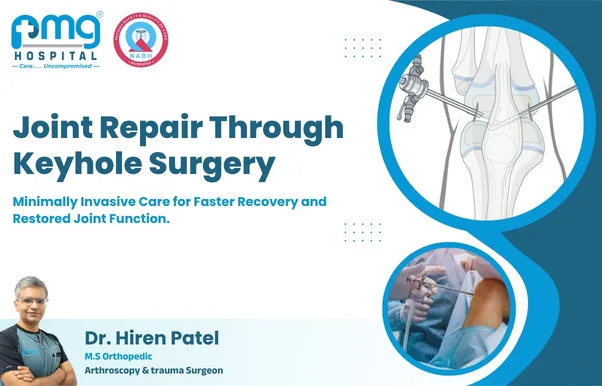
- Small keyhole portals
- Day-care or overnight admission, depending on the procedure
- Physiotherapy usually started soon after surgery
- Milestone-based return to sport
What Is Arthroscopy?
Arthroscopy is keyhole surgery on a joint. A small camera (an arthroscope) and fine instruments are passed through small portals, so that the surgeon can see inside the joint on a screen and treat it without opening it up. Because the muscles and soft tissues are disturbed less than in open surgery, pain, bleeding and stiffness are usually less, and recovery is often quicker. Arthroscopy is used to reconstruct torn ligaments, repair or trim a meniscus, treat cartilage damage, and treat a range of shoulder and hip problems.
Assessment Before Arthroscopy
An arthroscopy doctor in Ahmedabad — an orthopaedic surgeon trained in keyhole surgery — first examines the joint and arranges X-rays or an MRI scan where needed. Arthroscopy treatment in Ahmedabad is advised only when the examination and scans show a problem that keyhole surgery can treat; many joint problems settle with physiotherapy, changes in activity and medicines.
When you meet an arthroscopy consultant in Ahmedabad, bring your X-rays, MRI reports and a list of your current medicines, and ask what the procedure aims to achieve, what the alternatives are, and what recovery involves.
Knee Arthroscopy
ACL Reconstruction
Arthroscopic reconstruction of a torn anterior cruciate ligament for a knee that gives way after a sports or other injury, using a tendon graft and followed by a staged rehabilitation programme. Learn about ACL Reconstruction.
PCL Reconstruction
Treatment of a posterior cruciate ligament tear: careful grading, a brace and physiotherapy for many tears, and arthroscopic reconstruction for high-grade or combined injuries. Learn about PCL Reconstruction.
Meniscus Repair
Arthroscopic meniscus repair or partial meniscectomy for a knee that locks, swells or hurts with twisting, keeping as much of the meniscus as possible. Learn about Meniscus Repair.
Knee Dislocation
A dislocated knee tears several ligaments at once and puts the artery behind the knee at risk. Urgent reduction and circulation checks come first, followed by planned ligament reconstruction. Learn about Knee Dislocation.
Cartilage Restoration
Microfracture and osteochondral transfer (OATS) for localised cartilage defects, with a realignment osteotomy where the alignment of the leg overloads the damaged area. The aim is to relieve pain and protect the rest of the joint. Learn about Cartilage Restoration.
Hip Arthroscopy
Hip Arthroscopy
Keyhole surgery for femoroacetabular impingement (FAI), labral tears and groin pain in selected patients: the impinging bone is reshaped and, where possible, the torn labrum is repaired, with the aim of protecting the joint. Learn about Hip Arthroscopy.
Shoulder Arthroscopy
Rotator Cuff Repair
Arthroscopic repair of a torn rotator cuff, reattaching the tendon to the bone with anchors, for shoulder pain, weakness and night pain. Learn about Rotator Cuff Repair.
Biceps Tenodesis
For pain at the front of the shoulder from the long head of the biceps: the tendon is detached from inside the joint and fixed to the upper arm bone, so that the muscle keeps working. Learn about Biceps Tenodesis.
Shoulder Dislocation
Treatment ranges from prompt reduction of a first dislocation to arthroscopic Bankart repair for a shoulder that keeps dislocating, or a Latarjet procedure where bone has been lost from the socket. Learn about Shoulder Dislocation.
SLAP Tear
A tear of the upper rim of the socket where the biceps tendon attaches, causing deep pain and clicking in throwing and overhead sports; treated with physiotherapy, repair or a biceps tenodesis. Learn about SLAP Tear.
Frozen Shoulder
A painful, increasingly stiff shoulder, more common in people with diabetes. Many cases settle with an injection and structured physiotherapy; a release is considered when the stiffness does not settle. Learn about Frozen Shoulder.
Shoulder Bursitis
Inflammation of the bursa (a cushion) between the rotator cuff and the bone above it, causing a painful arc when lifting the arm. Most cases settle without surgery. Learn about Shoulder Bursitis.
Why Recovery Is Often Quicker After Keyhole Surgery
The camera and instruments enter through small portals, so there is less damage to the surrounding tissue than in open surgery. Physiotherapy usually starts soon after surgery, so the joint regains movement while it heals. This is why many arthroscopic procedures are done as day-care procedures or with a single night in hospital. Recovery still depends on what was done: a ligament reconstruction needs months of rehabilitation, even though it is done through keyhole incisions.
Sports Injury Care
Injuries from cricket, football, kabaddi, badminton and gym training are assessed with the patient's sport and goals in mind. Rehabilitation is milestone-based: strength, hop tests and balance decide the return to play, not a date on the calendar.
Risks and Possible Complications
Arthroscopy is generally a safe procedure, but like any surgery it has risks:
- Infection of the wound or inside the joint, which is uncommon but may need further surgery
- Bleeding into the joint or swelling that takes time to settle
- Blood clots in the leg veins (deep vein thrombosis) or lungs (pulmonary embolism)
- Stiffness or loss of movement
- Numbness of the skin around the incisions
- Injury to nerves or blood vessels during surgery, which is rare
- Continuing pain in some patients
- Anaesthesia-related and general medical risks
The surgeon explains the risks that apply to you before you decide on surgery.
How to Choose an Arthroscopy Surgeon in Ahmedabad
When choosing an arthroscopy surgeon in Ahmedabad, check that the surgeon is a qualified orthopaedic surgeon with valid medical council registration, that the procedure you need is performed regularly, how infection is prevented, which grafts, implants and tests are used, what physiotherapy and follow-up are provided, and what the written estimate includes.
Arthroscopic Surgery Cost in Ahmedabad
The cost depends on:
- The joint and the procedure, for example a meniscus trim or a ligament reconstruction
- Grafts and implants, such as anchors or fixation devices
- Day-care or overnight admission, and room category
- Tests such as an MRI scan
- Physiotherapy after surgery
A written, itemised estimate can be requested from the hospital after assessment.
Insurance
- Medically necessary arthroscopic surgery for an injury or a diagnosed joint problem is generally covered under health insurance policies, subject to policy terms, waiting periods and insurer approval
- Some policies have limits on room rent or implant costs; check these with your insurer before surgery
- Ask the hospital whether cashless treatment is available with your insurer, and which documents are needed
Arthroscopy Doctor in Ahmedabad
Keyhole joint surgery is carried out by an orthopaedic surgeon trained in arthroscopy, and some surgeons work mainly on one or two joints, such as the knee and the shoulder. People with joint pain often see a family doctor first; a joint that keeps locking, giving way or hurting despite treatment is usually referred to an arthroscopy consultant in Ahmedabad, meaning an orthopaedic surgeon who performs keyhole procedures. Several others share in the care:
| Doctor or therapist | Role in arthroscopic care |
|---|---|
| Family doctor | Treats early joint pain and refers when symptoms continue, or when the joint locks or gives way |
| Orthopaedic surgeon trained in arthroscopy | Examines the joint, studies the scans, decides whether keyhole surgery is needed and performs it |
| Radiologist | Performs and reports X-rays and MRI scans, sometimes with dye injected into the joint (MR arthrogram) |
| Anaesthetist | Gives spinal, general or regional (nerve block) anaesthesia, depending on the joint and the procedure |
| Physician | Checks blood sugar, blood pressure and fitness for anaesthesia in people with other illnesses |
| Physiotherapist | Plans the exercise programme before and after the operation and helps judge when sport can safely be resumed |
Arthroscopy Surgery Doctor in Ahmedabad
Clear answers before keyhole surgery help you know what is planned and what the weeks afterwards will involve. In addition to the topics in the FAQ below, you can ask your arthroscopy surgery doctor in Ahmedabad:
- Which structure in my joint is damaged, and how clearly do the scans show it?
- Is the plan a repair, a trim (removing only the torn part) or a reconstruction?
- Could the plan change once the camera shows the inside of the joint, and how will that be explained to me before surgery?
- Will I go home the same day, or stay one night?
- Will crutches, a brace or a sling be needed afterwards, and for how many weeks?
- How many weeks of physiotherapy will I need, and how much of it can be done at home?
- When can I drive, and when can I go back to work?
- Which symptoms after discharge mean I should contact the hospital promptly?
About the Treating Surgeon
At PMG Hospital, Gota, Ahmedabad, arthroscopic surgery is performed by:
| Detail | Information |
|---|---|
| Name | Dr. Hiren Patel |
| Qualification | MBBS, MS (Ortho), International Fellowship in Joint Replacement |
| Education | MBBS and MS (Ortho), B.J. Medical College, Ahmedabad |
| Specialty | Orthopaedics |
| Designation | Director & Head Joint Replacement Surgeon, PMG Hospital |
| Registration status | Registered Medical Practitioner |
| Registration number | Gujarat Medical Council Reg. No. G-20583 |
| OPD availability | Monday to Saturday, 10:00 AM – 8:00 PM; Sunday by appointment |
Facilities at PMG Hospital
- Orthopaedic OPD, Monday to Saturday; Sunday by appointment
- Emergency and trauma care, 24×7
- Orthopaedic physiotherapy
Frequently asked questions
Is arthroscopy considered major surgery?
Arthroscopy is minimally invasive and is often done as a day-care procedure, so recovery is usually easier than after open surgery. It is still real surgery done under anaesthesia. Depending on what is done, it can range from a short procedure to a significant operation, such as a ligament reconstruction, that rebuilds an important structure and needs a proper recovery.
How soon can I resume sport after arthroscopy?
It depends on what was done. After a simple meniscus trim, a return to sport may be possible within weeks, while after ACL reconstruction it usually takes around nine months or longer, and after PCL or multi-ligament surgery often longer. Return is decided by strength, hop tests and balance rather than a fixed date, because returning too early increases the risk of a new injury.
Is arthroscopy covered by insurance?
Arthroscopic surgery for an injury or a diagnosed joint problem is generally covered by health insurance, subject to policy terms and insurer approval. Cover for a purely diagnostic procedure should be confirmed with your insurer beforehand. Ask the hospital whether cashless treatment is available with your insurer; a written, itemised estimate can be requested after assessment.
Contact and Location
PMG Hospital
3rd Floor, Athena Avenue, B/H Jaguar Showroom, Nr. Eulogia Inn Hotel, Gota, Ahmedabad, Gujarat
Phone / WhatsApp: +91 96627 70141
Email: pmghospital.ahm@gmail.com
OPD: Monday to Saturday, 10:00 AM – 8:00 PM; Sunday by appointment
Emergency and trauma care: 24×7
Medically reviewed by Dr. Hiren Patel, MS (Ortho.), Joint Replacement Surgeon, PMG Hospital, Ahmedabad.